Cindy Jensen on Russell Island

THE ACCIDENTAL ISLANDER

I didn’t move to Russell Island because I had always dreamed of living on an island. In fact, until just over a year ago, I didn’t know where Russell Island was. I grew up in Brisbane for most of my childhood, and had somehow remained completely oblivious to the collection of islands sitting across the bay.

While working in Italy last year, I started wondering if it was time for a change from the Sunshine Coast. One night, I went on realestate.com, entered what I thought I could spend if I sold up, and started scrolling. Then I saw a house on Russell Island. I had to Google it. An island? Was I really considering moving to one?

The more I looked, the more intrigued I became. I sent the property to my daughters, who both immediately told me I’d be crazy to move there, followed by screenshots of Reddit threads detailing everything apparently wrong with Russell Island. They had perhaps forgotten who they were dealing with. I have never been particularly frightened by a decision that makes perfect sense to nobody else.

The day I arrived back in Australia, I rang LJ Hooker and organised to see the house the following day. I walked through it and immediately realised I didn’t want it. It was too big and far too much work for one person. What I actually needed was smaller and simpler. The agent mentioned that the same builder had a tiny home for sale and asked if I wanted to look. We drove into the driveway. There was an avocado tree. “Sold.” I hadn’t even seen the house.

Looking back, perhaps this wasn’t the most conventional approach to purchasing property, but something about the place felt right before I could explain why. When I stepped inside, that feeling only became stronger. It was small, different and completely outside the life I had been living, yet somehow exactly what I needed next.

A few days later, I returned with a friend to explore the area. We wandered off with nowhere particular to go and were approached by a woman in a car who said she hadn’t seen us around before and asked if we needed a lift. I explained I was looking at buying a house but had no idea where we were going. She offered to take us to the bowls club. Her name was Nell.

A few bottles of champagne later, we realised we weren’t going to be driving anywhere, so we started asking locals about somewhere to stay. People we had never met were offering us beds in their homes. Complete strangers were welcoming us as though we had somehow been misplaced and they were simply helping us get back where we belonged. We eventually booked a room at Marleys, and the next morning I woke up with one very clear realisation. I needed to live here.

It wasn’t the house or the avocado tree. It was the people. The friendliness, the sense of community and that laid back small town feeling immediately felt familiar. People noticed you, asked questions, offered help and looked out for one another. After years of moving around, I had stumbled across the one place that made me want to stop. So I bought the house and my daughters have since had to eat their words.

The strangest part was that moving somewhere where I knew absolutely nobody turned out to be one of the easiest transitions of my life, largely because of the Friendly Bay Islander. I knew I wanted to write, so shortly after arriving I reached out to Gerard and asked if there was any work. As luck would have it, there was. I was given an opportunity to prove myself, and what followed has been one of the most rewarding years of my working life.

Suddenly I was meeting people, being invited into workshops, studios, garages, sheds and homes and discovering just how much talent exists across these islands. But it’s not only the makers and creators who fascinate me. Some of my favourite stories have come from people who tell me they “don’t really have a story,” only to reveal a lifetime of adventures, resilience, heartbreak and unexpected twists. I’ve realised everyone has a story; sometimes they just need someone curious enough to ask. I feel incredibly lucky that my job gives me a reason to keep knocking on doors and finding them.

That became part of the inspiration for The Mooring, a social media page I started to showcase the positive side of island life. I wanted to celebrate the place I had fallen in love with, but I also remembered those screenshots my daughters had sent me. If someone was Googling what Russell Island was like, I wanted them to find the people and community I had discovered.

The Mooring grew quickly, and then it disappeared. After being reported, the pages were shut down, beginning 152 days of trying to get them reinstated. It was incredibly difficult, but it also showed me what this community is really about. People checked in, offered support and reached out.

The same thing happened with Somewhere Else, the concept show I created to introduce the community to new talent, fresh ideas and creative concepts. The third instalment, featuring Dan Hannaford, was about to be promoted when my pages went down. It would have been easy to give up, but the community got behind it and the show sold out. It reinforced something I had already begun to understand; communities are built by people choosing to support one another. And that is what I love about living here.

I also love that the woman who stopped to give me a lift on my second visit, Nell, is now one of my best friends and lives a few doors away. We drink on each other’s balconies, walk, do Pilates, share meals and have accumulated a wonderfully chaotic group of creative women around us. I love the curlews, the absence of traffic lights and the feeling that life has slowed down just enough to notice it happening. I love the ferry, the wildlife and my growing collection of feathered friends. I love my avocado tree, although I am determined this year to harvest enough fruit to share with the neighbours before the ibis take control. And I love the people whose stories remind me why I wanted to write in the first place.

Robert and Shane, sitting in the back of the ute at IGA, remain one of my favourite stories. Telling their story allowed people to see them a little differently. I still have people tell me they now say hello to them, that the story helped them understand their circumstances and motivations. Even better, members of the community started buying them coffees. That is the kind of impact I hope my writing can have. It doesn’t always need to change the world, sometimes it can simply change the way someone looks at another person.

And then there is Elissa. When I started with the paper, Gerard was at the helm. Shortly afterwards, Elissa found herself thrown into the deep end and taking over the magazine in its entirety. Watching her grow the publication from strength to strength, while supporting my ideas and always having my back, has been something I genuinely admire and am so grateful for.

So, one year on, I think about the woman sitting in Italy, staring at a property website because she felt like a new adventure was in order. She didn’t know where Russell Island was, didn’t know anyone there, had two daughters telling her she was crazy, and then bought a house because of an avocado tree. Somehow, she got it right.

A year later, I have a community, a newspaper full of stories and a growing collection of people I now call friends. I have a reason to get up every day and go looking for the next interesting person hiding behind a workshop door, inside a studio or somewhere in a shed.

For someone who has spent most of her life wondering where she might go next, it is a strange and wonderful feeling to finally wonder how long I get to stay. I think the answer might be forever.

Thank you to Gerard for giving me the opportunity to prove myself, to Elissa for believing in what I do, and to the entire island community for making a stranger feel like she belonged. I came here looking for a smaller house and a new beginning. Somewhere along the way, I found a much bigger thing. I found home.

Cindy Jensen on Russell Island

THE ACCIDENTAL ISLANDER

I didn’t move to Russell Island because I had always dreamed of living on an island. In fact, until just over a year ago, I didn’t know where Russell Island was. I grew up in Brisbane for most of my childhood, and had somehow remained completely oblivious to the collection of islands sitting across the bay.

While working in Italy last year, I started wondering if it was time for a change from the Sunshine Coast. One night, I went on realestate.com, entered what I thought I could spend if I sold up, and started scrolling. Then I saw a house on Russell Island. I had to Google it. An island? Was I really considering moving to one?

The more I looked, the more intrigued I became. I sent the property to my daughters, who both immediately told me I’d be crazy to move there, followed by screenshots of Reddit threads detailing everything apparently wrong with Russell Island. They had perhaps forgotten who they were dealing with. I have never been particularly frightened by a decision that makes perfect sense to nobody else.

The day I arrived back in Australia, I rang LJ Hooker and organised to see the house the following day. I walked through it and immediately realised I didn’t want it. It was too big and far too much work for one person. What I actually needed was smaller and simpler. The agent mentioned that the same builder had a tiny home for sale and asked if I wanted to look. We drove into the driveway. There was an avocado tree. “Sold.” I hadn’t even seen the house.

Looking back, perhaps this wasn’t the most conventional approach to purchasing property, but something about the place felt right before I could explain why. When I stepped inside, that feeling only became stronger. It was small, different and completely outside the life I had been living, yet somehow exactly what I needed next.

A few days later, I returned with a friend to explore the area. We wandered off with nowhere particular to go and were approached by a woman in a car who said she hadn’t seen us around before and asked if we needed a lift. I explained I was looking at buying a house but had no idea where we were going. She offered to take us to the bowls club. Her name was Nell.

A few bottles of champagne later, we realised we weren’t going to be driving anywhere, so we started asking locals about somewhere to stay. People we had never met were offering us beds in their homes. Complete strangers were welcoming us as though we had somehow been misplaced and they were simply helping us get back where we belonged. We eventually booked a room at Marleys, and the next morning I woke up with one very clear realisation. I needed to live here.

It wasn’t the house or the avocado tree. It was the people. The friendliness, the sense of community and that laid back small town feeling immediately felt familiar. People noticed you, asked questions, offered help and looked out for one another. After years of moving around, I had stumbled across the one place that made me want to stop. So I bought the house and my daughters have since had to eat their words.

The strangest part was that moving somewhere where I knew absolutely nobody turned out to be one of the easiest transitions of my life, largely because of the Friendly Bay Islander. I knew I wanted to write, so shortly after arriving I reached out to Gerard and asked if there was any work. As luck would have it, there was. I was given an opportunity to prove myself, and what followed has been one of the most rewarding years of my working life.

Suddenly I was meeting people, being invited into workshops, studios, garages, sheds and homes and discovering just how much talent exists across these islands. But it’s not only the makers and creators who fascinate me. Some of my favourite stories have come from people who tell me they “don’t really have a story,” only to reveal a lifetime of adventures, resilience, heartbreak and unexpected twists. I’ve realised everyone has a story; sometimes they just need someone curious enough to ask. I feel incredibly lucky that my job gives me a reason to keep knocking on doors and finding them.

That became part of the inspiration for The Mooring, a social media page I started to showcase the positive side of island life. I wanted to celebrate the place I had fallen in love with, but I also remembered those screenshots my daughters had sent me. If someone was Googling what Russell Island was like, I wanted them to find the people and community I had discovered.

The Mooring grew quickly, and then it disappeared. After being reported, the pages were shut down, beginning 152 days of trying to get them reinstated. It was incredibly difficult, but it also showed me what this community is really about. People checked in, offered support and reached out.

The same thing happened with Somewhere Else, the concept show I created to introduce the community to new talent, fresh ideas and creative concepts. The third instalment, featuring Dan Hannaford, was about to be promoted when my pages went down. It would have been easy to give up, but the community got behind it and the show sold out. It reinforced something I had already begun to understand; communities are built by people choosing to support one another. And that is what I love about living here.

I also love that the woman who stopped to give me a lift on my second visit, Nell, is now one of my best friends and lives a few doors away. We drink on each other’s balconies, walk, do Pilates, share meals and have accumulated a wonderfully chaotic group of creative women around us. I love the curlews, the absence of traffic lights and the feeling that life has slowed down just enough to notice it happening. I love the ferry, the wildlife and my growing collection of feathered friends. I love my avocado tree, although I am determined this year to harvest enough fruit to share with the neighbours before the ibis take control. And I love the people whose stories remind me why I wanted to write in the first place.

Robert and Shane, sitting in the back of the ute at IGA, remain one of my favourite stories. Telling their story allowed people to see them a little differently. I still have people tell me they now say hello to them, that the story helped them understand their circumstances and motivations. Even better, members of the community started buying them coffees. That is the kind of impact I hope my writing can have. It doesn’t always need to change the world, sometimes it can simply change the way someone looks at another person.

And then there is Elissa. When I started with the paper, Gerard was at the helm. Shortly afterwards, Elissa found herself thrown into the deep end and taking over the magazine in its entirety. Watching her grow the publication from strength to strength, while supporting my ideas and always having my back, has been something I genuinely admire and am so grateful for.

So, one year on, I think about the woman sitting in Italy, staring at a property website because she felt like a new adventure was in order. She didn’t know where Russell Island was, didn’t know anyone there, had two daughters telling her she was crazy, and then bought a house because of an avocado tree. Somehow, she got it right.

A year later, I have a community, a newspaper full of stories and a growing collection of people I now call friends. I have a reason to get up every day and go looking for the next interesting person hiding behind a workshop door, inside a studio or somewhere in a shed.

For someone who has spent most of her life wondering where she might go next, it is a strange and wonderful feeling to finally wonder how long I get to stay. I think the answer might be forever.

Thank you to Gerard for giving me the opportunity to prove myself, to Elissa for believing in what I do, and to the entire island community for making a stranger feel like she belonged. I came here looking for a smaller house and a new beginning. Somewhere along the way, I found a much bigger thing. I found home.

HOT GOSS

SICK LEAVE OR SWEET DEAL?

There’s been a bit of a stir over Mayor Jos Mitchell’s extended leave and, in particular, the fact that the Mayor remains on full pay while away from the job. Councillor Shane Rendalls has gone public with an open letter asking some fairly pointed questions. When is the Mayor coming back? Is a return actually planned? And, is it reasonable for ratepayers to continue footing the bill while the Mayor is unable to perform the role?

Now, before the pitchforks come out, nobody is suggesting that a person shouldn’t take time off when they’re genuinely unwell. Of course they should. Health comes first. But here’s where the conversation gets interesting. For most ordinary workers, paid sick leave is limited. Once that runs out, you may have annual leave, accrued leave or eventually, leave without pay. You generally don’t get to simply remain on your full salary indefinitely because your job happens to be an important one.

So, is the mayoral gig different? And if it is, should residents be told exactly why?

After all, $4,500 plus a week is a rather substantial amount of ratepayer money. At 31 weeks, that’s a figure well into six figures. The question isn’t necessarily “Should the Mayor be allowed to be sick?” That’s an easy one. The more interesting question is “What do we as residents think is fair?”

Should an elected official receive their full salary during an extended absence? Should there be a clearly defined limit? Should the rules be different for mayors and councillors? Or is this simply the price we pay for having elected representatives, even when they’re temporarily unable to work? And perhaps most importantly, would the average ratepayer consider the arrangement fair if it were their own workplace?

I’m asking readers. Where do you stand? Fair enough? A reasonable entitlement? Or something that deserves a much closer look? Have your say; I’d love to hear what you think. Email cindy@silentriotcollective.com.au.

A WORD ABOUT ALL THOSE ADS

You may have noticed there are a few more advertisements tucked into the magazine these days. There’s a good reason for that; local businesses are getting behind us in a bigger way than ever, and we couldn’t be more grateful.

As the magazine has grown, so has everything that goes along with it. More pages, more printing, more deliveries, more people involved, and considerably more effort and cost to get each copy from our hands into your letterbox. Our advertisers help make that possible. And, even better, we’re hearing some wonderful stories from local businesses who’ve picked up new customers simply because someone spotted them in these pages. That’s exactly the sort of thing we wanted the magazine to do.

Because really, the advertisements aren’t just there to fill space. They’re a handy little guide to the people, businesses and talents right here across the islands. There are so many fabulous local operators around that you can easily go years without knowing someone exists; right up until the moment you desperately need the very thing they happen to be brilliant at.

So, think of the ads as a local directory, with the added bonus that every one of them helps keep the magazine going. And behind the scenes, there are now more delivery people, a few more motorbikes, and a surprising amount of fuel and effort involved in the great operation of getting magazines into your hands. It all adds up, but the goal remains the same - keep the magazine free, keep it local, and keep delivering it to your letterbox for years to come.

I REALLY WISH I DIDN’T HAVE TO WRITE ABOUT THIS TOPIC.

Dog baiting. I’m hearing increasing concerns about dogs being deliberately baited, and if there is one thing I know about islanders, it’s that they are protective of their animals. So let’s be very clear about something. If someone is deliberately putting poison or bait down with the intention of harming someone’s dog, you are not invisible. More and more islanders are installing cameras around their homes and properties. There are people paying attention. There are ways to report suspicious behaviour, and there are proper channels for evidence to be investigated.

And if you think nobody will find out who you are, think again. I know from personal experience that when something matters to me, I don’t simply shrug my shoulders and walk away. If I came home one day and found my dog desperately sick, only to discover someone had deliberately baited him, I honestly don’t know how I would cope. Our dogs aren’t “just dogs”, they are family. They sleep in our homes, greet us at the door, follow us around and trust us completely. And deliberately poisoning an animal that has no idea what is happening? That is a despicable act.

So, to whoever is responsible, STOP. Because cameras are going up, people are talking, information can be reported and evidence can be collected. And if you are identified, you can expect the matter to be dealt with through the proper authorities.

To all the dog owners on the island, there is another side to this conversation too. Please be mindful about where your dogs are, particularly if they are allowed to roam or spend time outside unattended. Keep an eye on them, check your yards and take any unusual behaviour or suspicious substances seriously. And if you have evidence, CCTV footage, information, or genuinely believe you know something about deliberate baiting, please report it to Queensland Police. Let them investigate it properly.

NOBODY TOLD THE COMMUNITY THEY WERE SUPPOSED TO GIVE UP

When the funding doesn’t arrive, the rain starts falling and the odds are stacked against you, the response on the islands is simply; “Bugger it, we’ll do it ourselves.” And that, in a nutshell, is the story of the Fusion Festival, pulled together by Ros Stiles and the team at Bimsara.

Despite not receiving funding from Council, they forged ahead last month, fuelled by an extraordinary cocktail of community spirit, volunteers, performers, sponsors and people who have far too much energy and goodwill for their own good. And what a result! Fusion wasn’t just another festival, it was a collision of cultures, nationalities, traditional dance, colourful costumes and music. There were people from all walks of life coming together to celebrate what makes a multicultural community so much fun.

And then there was the food. I’m still thinking about the lamb curry. Honestly, I think it may have been the best lamb curry I’ve ever eaten, and I am prepared to start arguments over that statement. Even the drizzle that arrived in the morning couldn’t dampen the mood. Umbrellas went up, spirits stayed high and the show went on.

So a very big thank you to Ros and the Bimsara team, Simon Gordon, Clint Ling, Melissa Granato, John Jass, the volunteers, performers and everyone else who rolled up their sleeves to make the day happen. And, of course, to the sponsors and supporters who helped make Fusion possible: Island Life Property Sales & Rentals, Foundation for Rural Regional Renewal, SeaLink, Canaipa Lions, Macleay Lions, Island Ride, Property Centre, Kev the Chef, Henry Pike MP, Russell Island Post Office, Urban Island Removals and LiveLife Pharmacy.

If there’s one thing Fusion Festival proved, it’s that you can take away the funding, but you can’t take away the community. Here’s to Fusion returning in 2027!

HOT GOSSIP FROM THE FAIRWAY

Word around the island is that $5 could have you walking away with $15,000 cash, and that’s the kind of rumour I’m happy to spread. The Macleay Island Golf Club is shaking the money tree, with a $30,000 cash prize pool up for grabs; all in the name of raising funds for those much needed club renovations.

The prize money has been generously donated by the Bayside Community Bank & Bendigo Bank. And before you say “yeah, but nobody from around here ever wins,” last year’s $15,000 first prize lucky winner came from Lamb Island. Just sayin’.

The team will be out and about at markets, popping up around the place and generally making it difficult to avoid them. Tickets are also available at the club, so head on down, grab a raffle ticket, and enjoy a meal from Chef It Dining. Five bucks. Thirty grand in the pot. I’m not saying you should start checking the couch cushions, but I’m also not saying you shouldn’t.

Oct 6, 2026

7 min read

THE ACCIDENTAL ISLANDER

I didn’t move to Russell Island because I had always dreamed of living on an island. In fact, until just over a year ago, I didn’t know where Russell Island was. I grew up in Brisbane for most of my childhood, and had somehow remained completely oblivious to the collection of islands sitting across the bay.

While working in Italy last year, I started wondering if it was time for a change from the Sunshine Coast. One night, I went on realestate.com, entered what I thought I could spend if I sold up, and started scrolling. Then I saw a house on Russell Island. I had to Google it. An island? Was I really considering moving to one?

The more I looked, the more intrigued I became. I sent the property to my daughters, who both immediately told me I’d be crazy to move there, followed by screenshots of Reddit threads detailing everything apparently wrong with Russell Island. They had perhaps forgotten who they were dealing with. I have never been particularly frightened by a decision that makes perfect sense to nobody else.

The day I arrived back in Australia, I rang LJ Hooker and organised to see the house the following day. I walked through it and immediately realised I didn’t want it. It was too big and far too much work for one person. What I actually needed was smaller and simpler. The agent mentioned that the same builder had a tiny home for sale and asked if I wanted to look. We drove into the driveway. There was an avocado tree. “Sold.” I hadn’t even seen the house.

Looking back, perhaps this wasn’t the most conventional approach to purchasing property, but something about the place felt right before I could explain why. When I stepped inside, that feeling only became stronger. It was small, different and completely outside the life I had been living, yet somehow exactly what I needed next.

A few days later, I returned with a friend to explore the area. We wandered off with nowhere particular to go and were approached by a woman in a car who said she hadn’t seen us around before and asked if we needed a lift. I explained I was looking at buying a house but had no idea where we were going. She offered to take us to the bowls club. Her name was Nell.

A few bottles of champagne later, we realised we weren’t going to be driving anywhere, so we started asking locals about somewhere to stay. People we had never met were offering us beds in their homes. Complete strangers were welcoming us as though we had somehow been misplaced and they were simply helping us get back where we belonged. We eventually booked a room at Marleys, and the next morning I woke up with one very clear realisation. I needed to live here.

It wasn’t the house or the avocado tree. It was the people. The friendliness, the sense of community and that laid back small town feeling immediately felt familiar. People noticed you, asked questions, offered help and looked out for one another. After years of moving around, I had stumbled across the one place that made me want to stop. So I bought the house and my daughters have since had to eat their words.

The strangest part was that moving somewhere where I knew absolutely nobody turned out to be one of the easiest transitions of my life, largely because of the Friendly Bay Islander. I knew I wanted to write, so shortly after arriving I reached out to Gerard and asked if there was any work. As luck would have it, there was. I was given an opportunity to prove myself, and what followed has been one of the most rewarding years of my working life.

Suddenly I was meeting people, being invited into workshops, studios, garages, sheds and homes and discovering just how much talent exists across these islands. But it’s not only the makers and creators who fascinate me. Some of my favourite stories have come from people who tell me they “don’t really have a story,” only to reveal a lifetime of adventures, resilience, heartbreak and unexpected twists. I’ve realised everyone has a story; sometimes they just need someone curious enough to ask. I feel incredibly lucky that my job gives me a reason to keep knocking on doors and finding them.

That became part of the inspiration for The Mooring, a social media page I started to showcase the positive side of island life. I wanted to celebrate the place I had fallen in love with, but I also remembered those screenshots my daughters had sent me. If someone was Googling what Russell Island was like, I wanted them to find the people and community I had discovered.

The Mooring grew quickly, and then it disappeared. After being reported, the pages were shut down, beginning 152 days of trying to get them reinstated. It was incredibly difficult, but it also showed me what this community is really about. People checked in, offered support and reached out.

The same thing happened with Somewhere Else, the concept show I created to introduce the community to new talent, fresh ideas and creative concepts. The third instalment, featuring Dan Hannaford, was about to be promoted when my pages went down. It would have been easy to give up, but the community got behind it and the show sold out. It reinforced something I had already begun to understand; communities are built by people choosing to support one another. And that is what I love about living here.

I also love that the woman who stopped to give me a lift on my second visit, Nell, is now one of my best friends and lives a few doors away. We drink on each other’s balconies, walk, do Pilates, share meals and have accumulated a wonderfully chaotic group of creative women around us. I love the curlews, the absence of traffic lights and the feeling that life has slowed down just enough to notice it happening. I love the ferry, the wildlife and my growing collection of feathered friends. I love my avocado tree, although I am determined this year to harvest enough fruit to share with the neighbours before the ibis take control. And I love the people whose stories remind me why I wanted to write in the first place.

Robert and Shane, sitting in the back of the ute at IGA, remain one of my favourite stories. Telling their story allowed people to see them a little differently. I still have people tell me they now say hello to them, that the story helped them understand their circumstances and motivations. Even better, members of the community started buying them coffees. That is the kind of impact I hope my writing can have. It doesn’t always need to change the world, sometimes it can simply change the way someone looks at another person.

And then there is Elissa. When I started with the paper, Gerard was at the helm. Shortly afterwards, Elissa found herself thrown into the deep end and taking over the magazine in its entirety. Watching her grow the publication from strength to strength, while supporting my ideas and always having my back, has been something I genuinely admire and am so grateful for.

So, one year on, I think about the woman sitting in Italy, staring at a property website because she felt like a new adventure was in order. She didn’t know where Russell Island was, didn’t know anyone there, had two daughters telling her she was crazy, and then bought a house because of an avocado tree. Somehow, she got it right.

A year later, I have a community, a newspaper full of stories and a growing collection of people I now call friends. I have a reason to get up every day and go looking for the next interesting person hiding behind a workshop door, inside a studio or somewhere in a shed.

For someone who has spent most of her life wondering where she might go next, it is a strange and wonderful feeling to finally wonder how long I get to stay. I think the answer might be forever.

Thank you to Gerard for giving me the opportunity to prove myself, to Elissa for believing in what I do, and to the entire island community for making a stranger feel like she belonged. I came here looking for a smaller house and a new beginning. Somewhere along the way, I found a much bigger thing. I found home.

Oct 6, 2026

7 min read

Cindy Jensen on Russell Island

DAVID HOGAN AND THE ART OF MAKING QUIET

It started with a YouTube video and a curiosity that would eventually lead a former police officer to a very different kind of second career.

In 2009, David Hogan heard the sound of a Native American style flute on YouTube and was hooked. Not on the idea of becoming a musician, not on any romantic notion of claiming a culture that wasn’t his. He simply loved the sound.

So he bought a manual from a flute maker in the United States and taught himself how to make them.

David is particularly conscious of the cultural origins of the instrument. He makes no claim to Native American heritage or connection, and believes the line is crossed when people manufacture these instruments while pretending to have a cultural relationship they don’t have.

For around three years, he made flutes, then life changed and his workshop was packed away into a shipping container. For the next 12 years, the tools stayed there. The flutes didn’t, David kept a number of them and continued to play.

By then, music had begun to take on a significance that had little to do with performance. David had spent 21 years in the police service, including 14 years as a police officer in Eagleby and time as an acting sergeant on Russell Island. After years of seeing some of the harder sides of life, he discovered that sitting down with a flute could take him somewhere quieter.

“It’s a way to find calm and grounding and put me in a better place for the bad and difficult things I’ve seen,” David explained.

In 2017, David moved to Russell Island. The peace, the semi-rural atmosphere and the feeling of being close enough to the mainland without being swallowed up by it suited him.

After retiring from the police at 60, the flutes came back out. Today, they occupy his time in a very different kind of workshop.

At first glance, the instruments look almost deceptively simple; essentially a single piece of timber with a handful of holes. Musically, they are deliberately limited. A pentatonic scale uses just five notes, while David’s six hole design allows players to access Western pitches.

For a trained musician, that simplicity might be a restriction. For everyone else, David believes it is the secret.

“It’s musically very, very limited,” he says. “But the enabling of people to quickly be able to play music, you can’t beat it.”

Unlike the guitar, which can require years of practice before a beginner feels genuinely competent, David says the flute gives people an immediate way into making their own music.

“In a few hours of learning, you can make your own music and it’s your music.”

And perhaps that is where the real appeal lies, as you don’t have to be a musician and you don’t have to know much about music. You breathe, cover a few holes and something magical comes out.

The longer the flute, the deeper the pitch. David says those deeper tones can be particularly effective at helping people reach a meditative state.

“Most people struggle to get into a deep meditative state,” he says. “It’s not complicated and directly connected to your breathing.”

There is plenty of craftsmanship behind that apparent simplicity. David works predominantly with Australian timbers, including Mackay cedar, black wattle, Tasmanian blackwood, swamp mahogany, red cedar and spotted gum.

The journey from tree to flute is a long one. A stump is cut into a blank, turned into a cylinder and drilled before returning to the lathe for shaping. Then comes the intricate work of creating the nest and windway. The hardest part, David says, is cutting the true sound hole.

A mid range flute can take around 20 hours to make and prices generally range from $300 to $400, although there are some remarkable exceptions. David has a flute made from ancient New Zealand kauri, the timber around 4,000 years old, valued at $1,040.

But perhaps the most fitting flute in his collection began with one of those strange island coincidences that seem too unlikely to be coincidence at all. David was searching Marketplace for timber when he came across a man advertising logs from his timber mill. There was just one surprise. The timber mill owner lived on Russell Island. The tree had been cut down years earlier, and David saw the potential in the swamp mahogany. He made a flute from the timber and eventually exchanged his first logs for a flute. It seemed somehow inevitable that this would become the flute I would buy.

I’m learning to play it, slowly, and discovering that there is something satisfying about making music without needing to become a musician first. There is no grand performance involved, just five notes, a breath and a piece of Australian timber.

For David, the flutes have become more than a craft; they are a way of sharing the simple pleasure of making music and finding a little quiet along the way.

If you’re curious to hear more, see David’s handcrafted flutes and discover the story behind his work at www.canaipaflutes.com.au.

Oct 6, 2026

4 min read

David Hogan with one of his handcrafted flutes

HOT GOSS

SICK LEAVE OR SWEET DEAL?

There’s been a bit of a stir over Mayor Jos Mitchell’s extended leave and, in particular, the fact that the Mayor remains on full pay while away from the job. Councillor Shane Rendalls has gone public with an open letter asking some fairly pointed questions. When is the Mayor coming back? Is a return actually planned? And, is it reasonable for ratepayers to continue footing the bill while the Mayor is unable to perform the role?

Now, before the pitchforks come out, nobody is suggesting that a person shouldn’t take time off when they’re genuinely unwell. Of course they should. Health comes first. But here’s where the conversation gets interesting. For most ordinary workers, paid sick leave is limited. Once that runs out, you may have annual leave, accrued leave or eventually, leave without pay. You generally don’t get to simply remain on your full salary indefinitely because your job happens to be an important one.

So, is the mayoral gig different? And if it is, should residents be told exactly why?

After all, $4,500 plus a week is a rather substantial amount of ratepayer money. At 31 weeks, that’s a figure well into six figures. The question isn’t necessarily “Should the Mayor be allowed to be sick?” That’s an easy one. The more interesting question is “What do we as residents think is fair?”

Should an elected official receive their full salary during an extended absence? Should there be a clearly defined limit? Should the rules be different for mayors and councillors? Or is this simply the price we pay for having elected representatives, even when they’re temporarily unable to work? And perhaps most importantly, would the average ratepayer consider the arrangement fair if it were their own workplace?

I’m asking readers. Where do you stand? Fair enough? A reasonable entitlement? Or something that deserves a much closer look? Have your say; I’d love to hear what you think. Email cindy@silentriotcollective.com.au.

A WORD ABOUT ALL THOSE ADS

You may have noticed there are a few more advertisements tucked into the magazine these days. There’s a good reason for that; local businesses are getting behind us in a bigger way than ever, and we couldn’t be more grateful.

As the magazine has grown, so has everything that goes along with it. More pages, more printing, more deliveries, more people involved, and considerably more effort and cost to get each copy from our hands into your letterbox. Our advertisers help make that possible. And, even better, we’re hearing some wonderful stories from local businesses who’ve picked up new customers simply because someone spotted them in these pages. That’s exactly the sort of thing we wanted the magazine to do.

Because really, the advertisements aren’t just there to fill space. They’re a handy little guide to the people, businesses and talents right here across the islands. There are so many fabulous local operators around that you can easily go years without knowing someone exists; right up until the moment you desperately need the very thing they happen to be brilliant at.

So, think of the ads as a local directory, with the added bonus that every one of them helps keep the magazine going. And behind the scenes, there are now more delivery people, a few more motorbikes, and a surprising amount of fuel and effort involved in the great operation of getting magazines into your hands. It all adds up, but the goal remains the same - keep the magazine free, keep it local, and keep delivering it to your letterbox for years to come.

I REALLY WISH I DIDN’T HAVE TO WRITE ABOUT THIS TOPIC.

Dog baiting. I’m hearing increasing concerns about dogs being deliberately baited, and if there is one thing I know about islanders, it’s that they are protective of their animals. So let’s be very clear about something. If someone is deliberately putting poison or bait down with the intention of harming someone’s dog, you are not invisible. More and more islanders are installing cameras around their homes and properties. There are people paying attention. There are ways to report suspicious behaviour, and there are proper channels for evidence to be investigated.

And if you think nobody will find out who you are, think again. I know from personal experience that when something matters to me, I don’t simply shrug my shoulders and walk away. If I came home one day and found my dog desperately sick, only to discover someone had deliberately baited him, I honestly don’t know how I would cope. Our dogs aren’t “just dogs”, they are family. They sleep in our homes, greet us at the door, follow us around and trust us completely. And deliberately poisoning an animal that has no idea what is happening? That is a despicable act.

So, to whoever is responsible, STOP. Because cameras are going up, people are talking, information can be reported and evidence can be collected. And if you are identified, you can expect the matter to be dealt with through the proper authorities.

To all the dog owners on the island, there is another side to this conversation too. Please be mindful about where your dogs are, particularly if they are allowed to roam or spend time outside unattended. Keep an eye on them, check your yards and take any unusual behaviour or suspicious substances seriously. And if you have evidence, CCTV footage, information, or genuinely believe you know something about deliberate baiting, please report it to Queensland Police. Let them investigate it properly.

NOBODY TOLD THE COMMUNITY THEY WERE SUPPOSED TO GIVE UP

When the funding doesn’t arrive, the rain starts falling and the odds are stacked against you, the response on the islands is simply; “Bugger it, we’ll do it ourselves.” And that, in a nutshell, is the story of the Fusion Festival, pulled together by Ros Stiles and the team at Bimsara.

Despite not receiving funding from Council, they forged ahead last month, fuelled by an extraordinary cocktail of community spirit, volunteers, performers, sponsors and people who have far too much energy and goodwill for their own good. And what a result! Fusion wasn’t just another festival, it was a collision of cultures, nationalities, traditional dance, colourful costumes and music. There were people from all walks of life coming together to celebrate what makes a multicultural community so much fun.

And then there was the food. I’m still thinking about the lamb curry. Honestly, I think it may have been the best lamb curry I’ve ever eaten, and I am prepared to start arguments over that statement. Even the drizzle that arrived in the morning couldn’t dampen the mood. Umbrellas went up, spirits stayed high and the show went on.

So a very big thank you to Ros and the Bimsara team, Simon Gordon, Clint Ling, Melissa Granato, John Jass, the volunteers, performers and everyone else who rolled up their sleeves to make the day happen. And, of course, to the sponsors and supporters who helped make Fusion possible: Island Life Property Sales & Rentals, Foundation for Rural Regional Renewal, SeaLink, Canaipa Lions, Macleay Lions, Island Ride, Property Centre, Kev the Chef, Henry Pike MP, Russell Island Post Office, Urban Island Removals and LiveLife Pharmacy.

If there’s one thing Fusion Festival proved, it’s that you can take away the funding, but you can’t take away the community. Here’s to Fusion returning in 2027!

HOT GOSSIP FROM THE FAIRWAY

Word around the island is that $5 could have you walking away with $15,000 cash, and that’s the kind of rumour I’m happy to spread. The Macleay Island Golf Club is shaking the money tree, with a $30,000 cash prize pool up for grabs; all in the name of raising funds for those much needed club renovations.

The prize money has been generously donated by the Bayside Community Bank & Bendigo Bank. And before you say “yeah, but nobody from around here ever wins,” last year’s $15,000 first prize lucky winner came from Lamb Island. Just sayin’.

The team will be out and about at markets, popping up around the place and generally making it difficult to avoid them. Tickets are also available at the club, so head on down, grab a raffle ticket, and enjoy a meal from Chef It Dining. Five bucks. Thirty grand in the pot. I’m not saying you should start checking the couch cushions, but I’m also not saying you shouldn’t.

THE ACCIDENTAL ISLANDER

I didn’t move to Russell Island because I had always dreamed of living on an island. In fact, until just over a year ago, I didn’t know where Russell Island was. I grew up in Brisbane for most of my childhood, and had somehow remained completely oblivious to the collection of islands sitting across the bay.

While working in Italy last year, I started wondering if it was time for a change from the Sunshine Coast. One night, I went on realestate.com, entered what I thought I could spend if I sold up, and started scrolling. Then I saw a house on Russell Island. I had to Google it. An island? Was I really considering moving to one?

The more I looked, the more intrigued I became. I sent the property to my daughters, who both immediately told me I’d be crazy to move there, followed by screenshots of Reddit threads detailing everything apparently wrong with Russell Island. They had perhaps forgotten who they were dealing with. I have never been particularly frightened by a decision that makes perfect sense to nobody else.

The day I arrived back in Australia, I rang LJ Hooker and organised to see the house the following day. I walked through it and immediately realised I didn’t want it. It was too big and far too much work for one person. What I actually needed was smaller and simpler. The agent mentioned that the same builder had a tiny home for sale and asked if I wanted to look. We drove into the driveway. There was an avocado tree. “Sold.” I hadn’t even seen the house.

Looking back, perhaps this wasn’t the most conventional approach to purchasing property, but something about the place felt right before I could explain why. When I stepped inside, that feeling only became stronger. It was small, different and completely outside the life I had been living, yet somehow exactly what I needed next.

A few days later, I returned with a friend to explore the area. We wandered off with nowhere particular to go and were approached by a woman in a car who said she hadn’t seen us around before and asked if we needed a lift. I explained I was looking at buying a house but had no idea where we were going. She offered to take us to the bowls club. Her name was Nell.

A few bottles of champagne later, we realised we weren’t going to be driving anywhere, so we started asking locals about somewhere to stay. People we had never met were offering us beds in their homes. Complete strangers were welcoming us as though we had somehow been misplaced and they were simply helping us get back where we belonged. We eventually booked a room at Marleys, and the next morning I woke up with one very clear realisation. I needed to live here.

It wasn’t the house or the avocado tree. It was the people. The friendliness, the sense of community and that laid back small town feeling immediately felt familiar. People noticed you, asked questions, offered help and looked out for one another. After years of moving around, I had stumbled across the one place that made me want to stop. So I bought the house and my daughters have since had to eat their words.

The strangest part was that moving somewhere where I knew absolutely nobody turned out to be one of the easiest transitions of my life, largely because of the Friendly Bay Islander. I knew I wanted to write, so shortly after arriving I reached out to Gerard and asked if there was any work. As luck would have it, there was. I was given an opportunity to prove myself, and what followed has been one of the most rewarding years of my working life.

Suddenly I was meeting people, being invited into workshops, studios, garages, sheds and homes and discovering just how much talent exists across these islands. But it’s not only the makers and creators who fascinate me. Some of my favourite stories have come from people who tell me they “don’t really have a story,” only to reveal a lifetime of adventures, resilience, heartbreak and unexpected twists. I’ve realised everyone has a story; sometimes they just need someone curious enough to ask. I feel incredibly lucky that my job gives me a reason to keep knocking on doors and finding them.

That became part of the inspiration for The Mooring, a social media page I started to showcase the positive side of island life. I wanted to celebrate the place I had fallen in love with, but I also remembered those screenshots my daughters had sent me. If someone was Googling what Russell Island was like, I wanted them to find the people and community I had discovered.

The Mooring grew quickly, and then it disappeared. After being reported, the pages were shut down, beginning 152 days of trying to get them reinstated. It was incredibly difficult, but it also showed me what this community is really about. People checked in, offered support and reached out.

The same thing happened with Somewhere Else, the concept show I created to introduce the community to new talent, fresh ideas and creative concepts. The third instalment, featuring Dan Hannaford, was about to be promoted when my pages went down. It would have been easy to give up, but the community got behind it and the show sold out. It reinforced something I had already begun to understand; communities are built by people choosing to support one another. And that is what I love about living here.

I also love that the woman who stopped to give me a lift on my second visit, Nell, is now one of my best friends and lives a few doors away. We drink on each other’s balconies, walk, do Pilates, share meals and have accumulated a wonderfully chaotic group of creative women around us. I love the curlews, the absence of traffic lights and the feeling that life has slowed down just enough to notice it happening. I love the ferry, the wildlife and my growing collection of feathered friends. I love my avocado tree, although I am determined this year to harvest enough fruit to share with the neighbours before the ibis take control. And I love the people whose stories remind me why I wanted to write in the first place.

Robert and Shane, sitting in the back of the ute at IGA, remain one of my favourite stories. Telling their story allowed people to see them a little differently. I still have people tell me they now say hello to them, that the story helped them understand their circumstances and motivations. Even better, members of the community started buying them coffees. That is the kind of impact I hope my writing can have. It doesn’t always need to change the world, sometimes it can simply change the way someone looks at another person.

And then there is Elissa. When I started with the paper, Gerard was at the helm. Shortly afterwards, Elissa found herself thrown into the deep end and taking over the magazine in its entirety. Watching her grow the publication from strength to strength, while supporting my ideas and always having my back, has been something I genuinely admire and am so grateful for.

So, one year on, I think about the woman sitting in Italy, staring at a property website because she felt like a new adventure was in order. She didn’t know where Russell Island was, didn’t know anyone there, had two daughters telling her she was crazy, and then bought a house because of an avocado tree. Somehow, she got it right.

A year later, I have a community, a newspaper full of stories and a growing collection of people I now call friends. I have a reason to get up every day and go looking for the next interesting person hiding behind a workshop door, inside a studio or somewhere in a shed.

For someone who has spent most of her life wondering where she might go next, it is a strange and wonderful feeling to finally wonder how long I get to stay. I think the answer might be forever.

Thank you to Gerard for giving me the opportunity to prove myself, to Elissa for believing in what I do, and to the entire island community for making a stranger feel like she belonged. I came here looking for a smaller house and a new beginning. Somewhere along the way, I found a much bigger thing. I found home.

Cindy Jensen on Russell Island

DAVID HOGAN AND THE ART OF MAKING QUIET

It started with a YouTube video and a curiosity that would eventually lead a former police officer to a very different kind of second career.

In 2009, David Hogan heard the sound of a Native American style flute on YouTube and was hooked. Not on the idea of becoming a musician, not on any romantic notion of claiming a culture that wasn’t his. He simply loved the sound.

So he bought a manual from a flute maker in the United States and taught himself how to make them.

David is particularly conscious of the cultural origins of the instrument. He makes no claim to Native American heritage or connection, and believes the line is crossed when people manufacture these instruments while pretending to have a cultural relationship they don’t have.

For around three years, he made flutes, then life changed and his workshop was packed away into a shipping container. For the next 12 years, the tools stayed there. The flutes didn’t, David kept a number of them and continued to play.

By then, music had begun to take on a significance that had little to do with performance. David had spent 21 years in the police service, including 14 years as a police officer in Eagleby and time as an acting sergeant on Russell Island. After years of seeing some of the harder sides of life, he discovered that sitting down with a flute could take him somewhere quieter.

“It’s a way to find calm and grounding and put me in a better place for the bad and difficult things I’ve seen,” David explained.

In 2017, David moved to Russell Island. The peace, the semi-rural atmosphere and the feeling of being close enough to the mainland without being swallowed up by it suited him.

After retiring from the police at 60, the flutes came back out. Today, they occupy his time in a very different kind of workshop.

At first glance, the instruments look almost deceptively simple; essentially a single piece of timber with a handful of holes. Musically, they are deliberately limited. A pentatonic scale uses just five notes, while David’s six hole design allows players to access Western pitches.

For a trained musician, that simplicity might be a restriction. For everyone else, David believes it is the secret.

“It’s musically very, very limited,” he says. “But the enabling of people to quickly be able to play music, you can’t beat it.”

Unlike the guitar, which can require years of practice before a beginner feels genuinely competent, David says the flute gives people an immediate way into making their own music.

“In a few hours of learning, you can make your own music and it’s your music.”

And perhaps that is where the real appeal lies, as you don’t have to be a musician and you don’t have to know much about music. You breathe, cover a few holes and something magical comes out.

The longer the flute, the deeper the pitch. David says those deeper tones can be particularly effective at helping people reach a meditative state.

“Most people struggle to get into a deep meditative state,” he says. “It’s not complicated and directly connected to your breathing.”

There is plenty of craftsmanship behind that apparent simplicity. David works predominantly with Australian timbers, including Mackay cedar, black wattle, Tasmanian blackwood, swamp mahogany, red cedar and spotted gum.

The journey from tree to flute is a long one. A stump is cut into a blank, turned into a cylinder and drilled before returning to the lathe for shaping. Then comes the intricate work of creating the nest and windway. The hardest part, David says, is cutting the true sound hole.

A mid range flute can take around 20 hours to make and prices generally range from $300 to $400, although there are some remarkable exceptions. David has a flute made from ancient New Zealand kauri, the timber around 4,000 years old, valued at $1,040.

But perhaps the most fitting flute in his collection began with one of those strange island coincidences that seem too unlikely to be coincidence at all. David was searching Marketplace for timber when he came across a man advertising logs from his timber mill. There was just one surprise. The timber mill owner lived on Russell Island. The tree had been cut down years earlier, and David saw the potential in the swamp mahogany. He made a flute from the timber and eventually exchanged his first logs for a flute. It seemed somehow inevitable that this would become the flute I would buy.

I’m learning to play it, slowly, and discovering that there is something satisfying about making music without needing to become a musician first. There is no grand performance involved, just five notes, a breath and a piece of Australian timber.

For David, the flutes have become more than a craft; they are a way of sharing the simple pleasure of making music and finding a little quiet along the way.

If you’re curious to hear more, see David’s handcrafted flutes and discover the story behind his work at www.canaipaflutes.com.au.

David Hogan with one of his handcrafted flutes

FORGET AGEING GRACEFULLY

There’s a phrase I’ve never quite understood: ageing gracefully. It sounds terribly polite, a bit like being told to sit quietly, don’t make a fuss and try not to break anything. But spend any amount of time around people in their 50s, 60s, 70s and 80s and you quickly realise there’s not much graceful about it.

People are starting businesses, falling in love, travelling, learning to paint, riding bikes, dancing, renovating houses, looking after grandchildren, going back to work, leaving work and learning things they never had time for when they were younger. And occasionally doing things their children think are completely mad.

Perhaps that’s a healthier way to look at getting older. Not as a slow retreat from life, but as a time when you get a little more say in how you spend it.

Spring seems like a good time to have a go. Here on the islands, we have an advantage. We don’t have to look very far to find something that gets us out of the house. There’s the pool on Russell, the swimming enclosures around the islands and plenty of opportunities to get moving without turning it into a military exercise. A walk to the shops counts, gardening counts, walking the dog counts, climbing the stairs instead of taking the easy option counts, putting some music on and dancing around the kitchen absolutely counts.

And if you want something more structured, there are classes and activities happening across the islands, including yoga and Pilates with Jodie at Kevala Health and Fitness.

Jodie sees people at very different stages of life and says the conversation around exercise changes in our later years.

“As we get older, exercise becomes less about how we look and more about how we want to live. We want the strength to get up off the floor, carry the shopping, keep our balance, and continue doing the things we enjoy,” Jodie explains.

“You don’t have to be the strongest or the most flexible person in the room. Staying active is about keeping your confidence, your independence, and that feeling that your body can still take you where you want to go.”

That confidence is worth hanging on to. Being able to get down on the floor and get back up again is useful. So is being able to carry your shopping, step off a boat, negotiate an uneven footpath or climb a few stairs without giving it too much thought. And no, that doesn’t necessarily mean joining a gym. There are plenty of ways to build strength and movement into ordinary life.

But here’s the bit that often gets missed when we talk about healthy ageing. Your body isn’t the whole story. You need to give your brain something to do as well. You need people, things to look forward to, a reason to get dressed and leave the house, and something that makes you curious.

That might be an art class. It might be learning something new. It might be a workshop, music, photography or finally having a go at something you’ve been saying you’ll do for years. There are also sound healing sessions and other activities around the islands that might appeal to people who don’t necessarily think of themselves as “fitness people”.

And why not? Health isn’t just about how far you can walk. Sometimes it’s about whether you feel connected to the people around you. Sometimes it’s about having somewhere to go on a Tuesday morning. Sometimes it’s about sitting in a room with other people and making something with your hands, and sometimes it’s simply about having a laugh over a game of canasta.

And men, we’re talking to you too. There is a tendency to package this stuff as something for women. Yoga, Pilates, wellness and workshops. Some men hear those words and immediately develop an urgent need to clean the shed. But men need to keep moving, too. They need strength and balance, friends, things to do when work finishes or the kids have left home. They need somewhere to go that isn’t the doctor’s surgery or the pub.

The new 30? I’m not sure I’d go as far as saying 70 is the new 30. Your knees would definitely have a different opinion. But there is something to the idea that the old milestones don’t necessarily mean what they used to. Turning 50 doesn’t mean you’re old and neither does 60. At 70, there may still be plenty of firsts ahead of you, and at 80, you are certainly not required to become beige.

Perhaps the real luxury of getting older is knowing yourself a little better. You know what you like, you know what you don’t like, and you may have stopped worrying quite so much about impressing people. You might even have reached the stage where you can say, “No thanks, I don’t want to do that,” without spending three days feeling guilty about it. That’s progress.

So perhaps this spring isn’t about embarking on some heroic new health regime. Perhaps it’s about making just one small change. Try the class, take the walk, go to the art group, get back in the water, learn something, ring someone you haven’t seen for a while, or try something you’ve always thought wasn’t “for people your age”. You might surprise yourself.

Because getting older is going to happen whether we like it or not. The interesting part is what we do with it. And if your 50s, 60s, 70s or 80s happen to be some of the most interesting years you’ve had so far, that doesn’t sound much like ageing gracefully.

It sounds more like living.

Staying active and connected at every age

HOT GOSS

SICK LEAVE OR SWEET DEAL?

There’s been a bit of a stir over Mayor Jos Mitchell’s extended leave and, in particular, the fact that the Mayor remains on full pay while away from the job. Councillor Shane Rendalls has gone public with an open letter asking some fairly pointed questions. When is the Mayor coming back? Is a return actually planned? And, is it reasonable for ratepayers to continue footing the bill while the Mayor is unable to perform the role?

Now, before the pitchforks come out, nobody is suggesting that a person shouldn’t take time off when they’re genuinely unwell. Of course they should. Health comes first. But here’s where the conversation gets interesting. For most ordinary workers, paid sick leave is limited. Once that runs out, you may have annual leave, accrued leave or eventually, leave without pay. You generally don’t get to simply remain on your full salary indefinitely because your job happens to be an important one.

So, is the mayoral gig different? And if it is, should residents be told exactly why?

After all, $4,500 plus a week is a rather substantial amount of ratepayer money. At 31 weeks, that’s a figure well into six figures. The question isn’t necessarily “Should the Mayor be allowed to be sick?” That’s an easy one. The more interesting question is “What do we as residents think is fair?”

Should an elected official receive their full salary during an extended absence? Should there be a clearly defined limit? Should the rules be different for mayors and councillors? Or is this simply the price we pay for having elected representatives, even when they’re temporarily unable to work? And perhaps most importantly, would the average ratepayer consider the arrangement fair if it were their own workplace?

I’m asking readers. Where do you stand? Fair enough? A reasonable entitlement? Or something that deserves a much closer look? Have your say; I’d love to hear what you think. Email cindy@silentriotcollective.com.au.

A WORD ABOUT ALL THOSE ADS

You may have noticed there are a few more advertisements tucked into the magazine these days. There’s a good reason for that; local businesses are getting behind us in a bigger way than ever, and we couldn’t be more grateful.

As the magazine has grown, so has everything that goes along with it. More pages, more printing, more deliveries, more people involved, and considerably more effort and cost to get each copy from our hands into your letterbox. Our advertisers help make that possible. And, even better, we’re hearing some wonderful stories from local businesses who’ve picked up new customers simply because someone spotted them in these pages. That’s exactly the sort of thing we wanted the magazine to do.

Because really, the advertisements aren’t just there to fill space. They’re a handy little guide to the people, businesses and talents right here across the islands. There are so many fabulous local operators around that you can easily go years without knowing someone exists; right up until the moment you desperately need the very thing they happen to be brilliant at.

So, think of the ads as a local directory, with the added bonus that every one of them helps keep the magazine going. And behind the scenes, there are now more delivery people, a few more motorbikes, and a surprising amount of fuel and effort involved in the great operation of getting magazines into your hands. It all adds up, but the goal remains the same - keep the magazine free, keep it local, and keep delivering it to your letterbox for years to come.

I REALLY WISH I DIDN’T HAVE TO WRITE ABOUT THIS TOPIC.

Dog baiting. I’m hearing increasing concerns about dogs being deliberately baited, and if there is one thing I know about islanders, it’s that they are protective of their animals. So let’s be very clear about something. If someone is deliberately putting poison or bait down with the intention of harming someone’s dog, you are not invisible. More and more islanders are installing cameras around their homes and properties. There are people paying attention. There are ways to report suspicious behaviour, and there are proper channels for evidence to be investigated.

And if you think nobody will find out who you are, think again. I know from personal experience that when something matters to me, I don’t simply shrug my shoulders and walk away. If I came home one day and found my dog desperately sick, only to discover someone had deliberately baited him, I honestly don’t know how I would cope. Our dogs aren’t “just dogs”, they are family. They sleep in our homes, greet us at the door, follow us around and trust us completely. And deliberately poisoning an animal that has no idea what is happening? That is a despicable act.

So, to whoever is responsible, STOP. Because cameras are going up, people are talking, information can be reported and evidence can be collected. And if you are identified, you can expect the matter to be dealt with through the proper authorities.

To all the dog owners on the island, there is another side to this conversation too. Please be mindful about where your dogs are, particularly if they are allowed to roam or spend time outside unattended. Keep an eye on them, check your yards and take any unusual behaviour or suspicious substances seriously. And if you have evidence, CCTV footage, information, or genuinely believe you know something about deliberate baiting, please report it to Queensland Police. Let them investigate it properly.

NOBODY TOLD THE COMMUNITY THEY WERE SUPPOSED TO GIVE UP

When the funding doesn’t arrive, the rain starts falling and the odds are stacked against you, the response on the islands is simply; “Bugger it, we’ll do it ourselves.” And that, in a nutshell, is the story of the Fusion Festival, pulled together by Ros Stiles and the team at Bimsara.

Despite not receiving funding from Council, they forged ahead last month, fuelled by an extraordinary cocktail of community spirit, volunteers, performers, sponsors and people who have far too much energy and goodwill for their own good. And what a result! Fusion wasn’t just another festival, it was a collision of cultures, nationalities, traditional dance, colourful costumes and music. There were people from all walks of life coming together to celebrate what makes a multicultural community so much fun.

And then there was the food. I’m still thinking about the lamb curry. Honestly, I think it may have been the best lamb curry I’ve ever eaten, and I am prepared to start arguments over that statement. Even the drizzle that arrived in the morning couldn’t dampen the mood. Umbrellas went up, spirits stayed high and the show went on.

So a very big thank you to Ros and the Bimsara team, Simon Gordon, Clint Ling, Melissa Granato, John Jass, the volunteers, performers and everyone else who rolled up their sleeves to make the day happen. And, of course, to the sponsors and supporters who helped make Fusion possible: Island Life Property Sales & Rentals, Foundation for Rural Regional Renewal, SeaLink, Canaipa Lions, Macleay Lions, Island Ride, Property Centre, Kev the Chef, Henry Pike MP, Russell Island Post Office, Urban Island Removals and LiveLife Pharmacy.

If there’s one thing Fusion Festival proved, it’s that you can take away the funding, but you can’t take away the community. Here’s to Fusion returning in 2027!

HOT GOSSIP FROM THE FAIRWAY

Word around the island is that $5 could have you walking away with $15,000 cash, and that’s the kind of rumour I’m happy to spread. The Macleay Island Golf Club is shaking the money tree, with a $30,000 cash prize pool up for grabs; all in the name of raising funds for those much needed club renovations.

The prize money has been generously donated by the Bayside Community Bank & Bendigo Bank. And before you say “yeah, but nobody from around here ever wins,” last year’s $15,000 first prize lucky winner came from Lamb Island. Just sayin’.

The team will be out and about at markets, popping up around the place and generally making it difficult to avoid them. Tickets are also available at the club, so head on down, grab a raffle ticket, and enjoy a meal from Chef It Dining. Five bucks. Thirty grand in the pot. I’m not saying you should start checking the couch cushions, but I’m also not saying you shouldn’t.

THE ACCIDENTAL ISLANDER

I didn’t move to Russell Island because I had always dreamed of living on an island. In fact, until just over a year ago, I didn’t know where Russell Island was. I grew up in Brisbane for most of my childhood, and had somehow remained completely oblivious to the collection of islands sitting across the bay.

While working in Italy last year, I started wondering if it was time for a change from the Sunshine Coast. One night, I went on realestate.com, entered what I thought I could spend if I sold up, and started scrolling. Then I saw a house on Russell Island. I had to Google it. An island? Was I really considering moving to one?

The more I looked, the more intrigued I became. I sent the property to my daughters, who both immediately told me I’d be crazy to move there, followed by screenshots of Reddit threads detailing everything apparently wrong with Russell Island. They had perhaps forgotten who they were dealing with. I have never been particularly frightened by a decision that makes perfect sense to nobody else.

The day I arrived back in Australia, I rang LJ Hooker and organised to see the house the following day. I walked through it and immediately realised I didn’t want it. It was too big and far too much work for one person. What I actually needed was smaller and simpler. The agent mentioned that the same builder had a tiny home for sale and asked if I wanted to look. We drove into the driveway. There was an avocado tree. “Sold.” I hadn’t even seen the house.

Looking back, perhaps this wasn’t the most conventional approach to purchasing property, but something about the place felt right before I could explain why. When I stepped inside, that feeling only became stronger. It was small, different and completely outside the life I had been living, yet somehow exactly what I needed next.

A few days later, I returned with a friend to explore the area. We wandered off with nowhere particular to go and were approached by a woman in a car who said she hadn’t seen us around before and asked if we needed a lift. I explained I was looking at buying a house but had no idea where we were going. She offered to take us to the bowls club. Her name was Nell.

A few bottles of champagne later, we realised we weren’t going to be driving anywhere, so we started asking locals about somewhere to stay. People we had never met were offering us beds in their homes. Complete strangers were welcoming us as though we had somehow been misplaced and they were simply helping us get back where we belonged. We eventually booked a room at Marleys, and the next morning I woke up with one very clear realisation. I needed to live here.

It wasn’t the house or the avocado tree. It was the people. The friendliness, the sense of community and that laid back small town feeling immediately felt familiar. People noticed you, asked questions, offered help and looked out for one another. After years of moving around, I had stumbled across the one place that made me want to stop. So I bought the house and my daughters have since had to eat their words.

The strangest part was that moving somewhere where I knew absolutely nobody turned out to be one of the easiest transitions of my life, largely because of the Friendly Bay Islander. I knew I wanted to write, so shortly after arriving I reached out to Gerard and asked if there was any work. As luck would have it, there was. I was given an opportunity to prove myself, and what followed has been one of the most rewarding years of my working life.

Suddenly I was meeting people, being invited into workshops, studios, garages, sheds and homes and discovering just how much talent exists across these islands. But it’s not only the makers and creators who fascinate me. Some of my favourite stories have come from people who tell me they “don’t really have a story,” only to reveal a lifetime of adventures, resilience, heartbreak and unexpected twists. I’ve realised everyone has a story; sometimes they just need someone curious enough to ask. I feel incredibly lucky that my job gives me a reason to keep knocking on doors and finding them.

That became part of the inspiration for The Mooring, a social media page I started to showcase the positive side of island life. I wanted to celebrate the place I had fallen in love with, but I also remembered those screenshots my daughters had sent me. If someone was Googling what Russell Island was like, I wanted them to find the people and community I had discovered.

The Mooring grew quickly, and then it disappeared. After being reported, the pages were shut down, beginning 152 days of trying to get them reinstated. It was incredibly difficult, but it also showed me what this community is really about. People checked in, offered support and reached out.

The same thing happened with Somewhere Else, the concept show I created to introduce the community to new talent, fresh ideas and creative concepts. The third instalment, featuring Dan Hannaford, was about to be promoted when my pages went down. It would have been easy to give up, but the community got behind it and the show sold out. It reinforced something I had already begun to understand; communities are built by people choosing to support one another. And that is what I love about living here.

I also love that the woman who stopped to give me a lift on my second visit, Nell, is now one of my best friends and lives a few doors away. We drink on each other’s balconies, walk, do Pilates, share meals and have accumulated a wonderfully chaotic group of creative women around us. I love the curlews, the absence of traffic lights and the feeling that life has slowed down just enough to notice it happening. I love the ferry, the wildlife and my growing collection of feathered friends. I love my avocado tree, although I am determined this year to harvest enough fruit to share with the neighbours before the ibis take control. And I love the people whose stories remind me why I wanted to write in the first place.

Robert and Shane, sitting in the back of the ute at IGA, remain one of my favourite stories. Telling their story allowed people to see them a little differently. I still have people tell me they now say hello to them, that the story helped them understand their circumstances and motivations. Even better, members of the community started buying them coffees. That is the kind of impact I hope my writing can have. It doesn’t always need to change the world, sometimes it can simply change the way someone looks at another person.

And then there is Elissa. When I started with the paper, Gerard was at the helm. Shortly afterwards, Elissa found herself thrown into the deep end and taking over the magazine in its entirety. Watching her grow the publication from strength to strength, while supporting my ideas and always having my back, has been something I genuinely admire and am so grateful for.

So, one year on, I think about the woman sitting in Italy, staring at a property website because she felt like a new adventure was in order. She didn’t know where Russell Island was, didn’t know anyone there, had two daughters telling her she was crazy, and then bought a house because of an avocado tree. Somehow, she got it right.

A year later, I have a community, a newspaper full of stories and a growing collection of people I now call friends. I have a reason to get up every day and go looking for the next interesting person hiding behind a workshop door, inside a studio or somewhere in a shed.

For someone who has spent most of her life wondering where she might go next, it is a strange and wonderful feeling to finally wonder how long I get to stay. I think the answer might be forever.

Thank you to Gerard for giving me the opportunity to prove myself, to Elissa for believing in what I do, and to the entire island community for making a stranger feel like she belonged. I came here looking for a smaller house and a new beginning. Somewhere along the way, I found a much bigger thing. I found home.

Cindy Jensen on Russell Island

DAVID HOGAN AND THE ART OF MAKING QUIET

It started with a YouTube video and a curiosity that would eventually lead a former police officer to a very different kind of second career.

In 2009, David Hogan heard the sound of a Native American style flute on YouTube and was hooked. Not on the idea of becoming a musician, not on any romantic notion of claiming a culture that wasn’t his. He simply loved the sound.

So he bought a manual from a flute maker in the United States and taught himself how to make them.

David is particularly conscious of the cultural origins of the instrument. He makes no claim to Native American heritage or connection, and believes the line is crossed when people manufacture these instruments while pretending to have a cultural relationship they don’t have.

For around three years, he made flutes, then life changed and his workshop was packed away into a shipping container. For the next 12 years, the tools stayed there. The flutes didn’t, David kept a number of them and continued to play.

By then, music had begun to take on a significance that had little to do with performance. David had spent 21 years in the police service, including 14 years as a police officer in Eagleby and time as an acting sergeant on Russell Island. After years of seeing some of the harder sides of life, he discovered that sitting down with a flute could take him somewhere quieter.

“It’s a way to find calm and grounding and put me in a better place for the bad and difficult things I’ve seen,” David explained.

In 2017, David moved to Russell Island. The peace, the semi-rural atmosphere and the feeling of being close enough to the mainland without being swallowed up by it suited him.

After retiring from the police at 60, the flutes came back out. Today, they occupy his time in a very different kind of workshop.

At first glance, the instruments look almost deceptively simple; essentially a single piece of timber with a handful of holes. Musically, they are deliberately limited. A pentatonic scale uses just five notes, while David’s six hole design allows players to access Western pitches.

For a trained musician, that simplicity might be a restriction. For everyone else, David believes it is the secret.

“It’s musically very, very limited,” he says. “But the enabling of people to quickly be able to play music, you can’t beat it.”

Unlike the guitar, which can require years of practice before a beginner feels genuinely competent, David says the flute gives people an immediate way into making their own music.

“In a few hours of learning, you can make your own music and it’s your music.”

And perhaps that is where the real appeal lies, as you don’t have to be a musician and you don’t have to know much about music. You breathe, cover a few holes and something magical comes out.

The longer the flute, the deeper the pitch. David says those deeper tones can be particularly effective at helping people reach a meditative state.

“Most people struggle to get into a deep meditative state,” he says. “It’s not complicated and directly connected to your breathing.”

There is plenty of craftsmanship behind that apparent simplicity. David works predominantly with Australian timbers, including Mackay cedar, black wattle, Tasmanian blackwood, swamp mahogany, red cedar and spotted gum.

The journey from tree to flute is a long one. A stump is cut into a blank, turned into a cylinder and drilled before returning to the lathe for shaping. Then comes the intricate work of creating the nest and windway. The hardest part, David says, is cutting the true sound hole.

A mid range flute can take around 20 hours to make and prices generally range from $300 to $400, although there are some remarkable exceptions. David has a flute made from ancient New Zealand kauri, the timber around 4,000 years old, valued at $1,040.

But perhaps the most fitting flute in his collection began with one of those strange island coincidences that seem too unlikely to be coincidence at all. David was searching Marketplace for timber when he came across a man advertising logs from his timber mill. There was just one surprise. The timber mill owner lived on Russell Island. The tree had been cut down years earlier, and David saw the potential in the swamp mahogany. He made a flute from the timber and eventually exchanged his first logs for a flute. It seemed somehow inevitable that this would become the flute I would buy.

I’m learning to play it, slowly, and discovering that there is something satisfying about making music without needing to become a musician first. There is no grand performance involved, just five notes, a breath and a piece of Australian timber.

For David, the flutes have become more than a craft; they are a way of sharing the simple pleasure of making music and finding a little quiet along the way.

If you’re curious to hear more, see David’s handcrafted flutes and discover the story behind his work at www.canaipaflutes.com.au.

David Hogan with one of his handcrafted flutes

FORGET AGEING GRACEFULLY

There’s a phrase I’ve never quite understood: ageing gracefully. It sounds terribly polite, a bit like being told to sit quietly, don’t make a fuss and try not to break anything. But spend any amount of time around people in their 50s, 60s, 70s and 80s and you quickly realise there’s not much graceful about it.

People are starting businesses, falling in love, travelling, learning to paint, riding bikes, dancing, renovating houses, looking after grandchildren, going back to work, leaving work and learning things they never had time for when they were younger. And occasionally doing things their children think are completely mad.

Perhaps that’s a healthier way to look at getting older. Not as a slow retreat from life, but as a time when you get a little more say in how you spend it.

Spring seems like a good time to have a go. Here on the islands, we have an advantage. We don’t have to look very far to find something that gets us out of the house. There’s the pool on Russell, the swimming enclosures around the islands and plenty of opportunities to get moving without turning it into a military exercise. A walk to the shops counts, gardening counts, walking the dog counts, climbing the stairs instead of taking the easy option counts, putting some music on and dancing around the kitchen absolutely counts.

And if you want something more structured, there are classes and activities happening across the islands, including yoga and Pilates with Jodie at Kevala Health and Fitness.

Jodie sees people at very different stages of life and says the conversation around exercise changes in our later years.

“As we get older, exercise becomes less about how we look and more about how we want to live. We want the strength to get up off the floor, carry the shopping, keep our balance, and continue doing the things we enjoy,” Jodie explains.

“You don’t have to be the strongest or the most flexible person in the room. Staying active is about keeping your confidence, your independence, and that feeling that your body can still take you where you want to go.”

That confidence is worth hanging on to. Being able to get down on the floor and get back up again is useful. So is being able to carry your shopping, step off a boat, negotiate an uneven footpath or climb a few stairs without giving it too much thought. And no, that doesn’t necessarily mean joining a gym. There are plenty of ways to build strength and movement into ordinary life.

But here’s the bit that often gets missed when we talk about healthy ageing. Your body isn’t the whole story. You need to give your brain something to do as well. You need people, things to look forward to, a reason to get dressed and leave the house, and something that makes you curious.

That might be an art class. It might be learning something new. It might be a workshop, music, photography or finally having a go at something you’ve been saying you’ll do for years. There are also sound healing sessions and other activities around the islands that might appeal to people who don’t necessarily think of themselves as “fitness people”.

And why not? Health isn’t just about how far you can walk. Sometimes it’s about whether you feel connected to the people around you. Sometimes it’s about having somewhere to go on a Tuesday morning. Sometimes it’s about sitting in a room with other people and making something with your hands, and sometimes it’s simply about having a laugh over a game of canasta.

And men, we’re talking to you too. There is a tendency to package this stuff as something for women. Yoga, Pilates, wellness and workshops. Some men hear those words and immediately develop an urgent need to clean the shed. But men need to keep moving, too. They need strength and balance, friends, things to do when work finishes or the kids have left home. They need somewhere to go that isn’t the doctor’s surgery or the pub.

The new 30? I’m not sure I’d go as far as saying 70 is the new 30. Your knees would definitely have a different opinion. But there is something to the idea that the old milestones don’t necessarily mean what they used to. Turning 50 doesn’t mean you’re old and neither does 60. At 70, there may still be plenty of firsts ahead of you, and at 80, you are certainly not required to become beige.

Perhaps the real luxury of getting older is knowing yourself a little better. You know what you like, you know what you don’t like, and you may have stopped worrying quite so much about impressing people. You might even have reached the stage where you can say, “No thanks, I don’t want to do that,” without spending three days feeling guilty about it. That’s progress.

So perhaps this spring isn’t about embarking on some heroic new health regime. Perhaps it’s about making just one small change. Try the class, take the walk, go to the art group, get back in the water, learn something, ring someone you haven’t seen for a while, or try something you’ve always thought wasn’t “for people your age”. You might surprise yourself.

Because getting older is going to happen whether we like it or not. The interesting part is what we do with it. And if your 50s, 60s, 70s or 80s happen to be some of the most interesting years you’ve had so far, that doesn’t sound much like ageing gracefully.

It sounds more like living.

Staying active and connected at every age

THE WASTEWATER PROBLEM WE CAN NO LONGER FLUSH AWAY

For more than half a century, the Southern Moreton Bay Islands have grown around a problem that has never really been solved.

Since the small lot subdivisions of the early 1970s were transferred to the Redland Shire in 1973, Russell, Macleay, Lamb and Karragarra have developed without a centralised sewerage system connecting them to the mainland. Instead, wastewater has remained largely a matter for individual property owners, individual septic systems and individual household compliance.

For Shane Rendalls, that approach has reached its limits.

“Doing nothing is not a strategy,” Rendalls says. “It is sitting on an environmental and public health time bomb, simply hoping you aren’t the one sitting on it when it finally goes off.”

The issue is becoming harder to ignore as the islands continue to develop. Only around 43 per cent of the approved residential lots have currently been developed, while future development could see thousands more dwellings and a population approaching 20,000 people over the next decade or so.

That raises an uncomfortable question. If the existing wastewater arrangements are already creating problems, what happens when there are substantially more homes, more people and more wastewater?

Rendalls argues that the answer cannot simply be to continue managing the problem property by property.

For decades, wastewater on the islands has generally been treated as a backyard engineering and compliance issue. A household installs a treatment system, maintains it, pumps it out and, provided it meets the relevant requirements, life goes on.

But wastewater does not necessarily respect property boundaries. On the islands’ relatively small residential lots, there can be limited space available for safely dispersing treated wastewater once houses, tanks, driveways, setbacks and other infrastructure are taken into account. When systems fail, absorption areas become saturated, or heavy rainfall overwhelms a system, wastewater can move beyond the property on which it was generated.

That is when an individual wastewater problem can become a neighbourhood problem.

“Neighbouring residents face backyard biosecurity hazards from aging, overloaded uphill septic tanks, generating public health risks and intense civil disputes that Council is currently forced to mediate,” Rendalls says.

The technology itself has changed considerably since the islands were first developed. Early systems were basic arrangements in which toilet waste and greywater were dealt with using relatively crude methods. From the 1980s and 1990s, conventional septic tanks and absorption trenches became widespread. More recently, mechanical home sewage treatment plants and pressure compensating irrigation systems have provided substantially more sophisticated treatment and dispersal.

There are also newer passive systems entering the market that do not require continuous electrical power. But better technology does not necessarily solve a problem when the fundamental constraint is the amount of land available to safely receive the wastewater.

This is where the islands’ small blocks become particularly important. Australian wastewater standards require land application areas to be appropriately sized for the expected wastewater load and the characteristics of the site. On a typical 500 or 600 square metre island block, the available area can become very constrained once everything else that occupies the property is taken into account. The result is a system that can sometimes feel like a constant balancing act: the size of the house, the number of occupants, the treatment technology and the available land all have to work together.

And then there is the weather. Heavy rainfall can saturate soils and overwhelm absorption areas. In a subtropical coastal environment, that creates another pathway by which wastewater and nutrients can move through the landscape.

Rendalls is particularly concerned about what happens when that movement ultimately reaches Moreton Bay. Wastewater contains nutrients including nitrogen and phosphorus. In the wrong circumstances, excessive nutrient loads entering waterways can contribute to algal growth and ecological impacts. The islands sit within a highly sensitive coastal environment, with the Moreton Bay ecosystem supporting important seagrass habitats and marine species including dugongs and green turtles.

The point, Rendalls argues, is not that every onsite system is failing or that every backyard is contaminating the bay. Rather, the risk lies in having thousands of individual systems operating across a growing island population without a coordinated regional wastewater strategy.

“It is not enough to ask whether an individual household system complies with the rules, and we need to ask whether the system as a whole is sustainable as the islands continue to grow,” he says.

There is another dimension to the problem that is less visible to residents but potentially significant for local businesses. Commercial wastewater can trigger a different regulatory regime once volumes exceed the relevant threshold. Rendalls points to the 4,200 litre per day threshold associated with Environmentally Relevant Activity 63, which can bring state environmental regulation and additional approval requirements into play.

For an island business, wastewater is therefore not simply a plumbing problem. It can become an economic development issue. Additional engineering, land requirements, licensing and pumping costs can make commercial development considerably more complicated than it would be in a mainland suburb with access to reticulated sewerage.

That creates a strange contradiction for an area that is expected to continue growing. We want local businesses. We want shops, hospitality, community services and employment opportunities. We want people to be able to build homes and invest in their properties. But the infrastructure underneath that growth matters. You cannot build a sustainable community while pretending that what happens after we flush the toilet is somebody else’s problem.

Rendalls believes the islands need to move beyond the traditional argument about whether sewerage is affordable and begin by establishing exactly what the problem is, what options are available and what the community is prepared to support. Importantly, that does not necessarily mean assuming that one particular sewerage model is the answer.

A mainland style reticulated sewer system across all four islands may be one option. But there may also be alternatives, including localised wastewater systems, targeted infrastructure for commercial precincts, regulatory changes designed specifically for the islands, or other technologies that have not yet been properly assessed in the SMBI context.

The first step, he argues, should therefore be evidence. His proposal is for a community led process that begins with a comprehensive review of what is already known. That would include examining academic and professional research into onsite wastewater treatment, reviewing the performance of different technologies, mapping historical Council plumbing and wastewater records, and understanding the actual experiences of island residents.

Just as importantly, residents would be asked what they want. That includes the uncomfortable question of what people would actually be prepared to pay. A sewerage system is not free. Neither are septic tanks, treatment plants, pump outs, repairs, replacement systems and compliance.

The real comparison is therefore not necessarily “free onsite system versus expensive sewerage”. It is the long term cost of maintaining thousands of individual systems compared with the capital and ongoing costs of some form of shared infrastructure. Businesses would need to have their own conversation about the issue, particularly around development constraints and the additional regulatory burden that wastewater can create.

Rendalls proposes separate forums for residents and businesses so that both perspectives can be properly explored. There is also a proposal for community based environmental monitoring.

Residents with appropriate training could participate in citizen science testing of backyard groundwater bores and monitor what happens during the “first flush” of heavy rainfall, when accumulated material can be washed rapidly through the landscape towards the waterways.

Done properly, that sort of community science is not about manufacturing a predetermined result. It is about building a better picture of what is actually happening on the islands. And that distinction is important.

If the SMBI is going to make a serious case to the State and Federal governments for infrastructure funding, it needs more than frustration. It needs evidence. It needs data on population growth, wastewater volumes, system performance, environmental conditions, regulatory barriers, community preferences and the costs of the available options.

Rendalls says his professional networks through the Onsite Wastewater Treatment Association and local government forums can help connect the community with researchers, engineers, regulators and wastewater specialists.

“Government departments cannot dismiss this campaign as mere community sentiment,” he says. “It is a scientifically rigorous initiative guided by industry experts.”

That is an ambitious claim, but it also points to what may be the most important shift in the debate. The islands have spent decades dealing with wastewater one property at a time and perhaps the time has come to start dealing with it as a community.

The argument is not simply about toilets, septic tanks or sewer pipes. It is about what sort of community the Southern Moreton Bay Islands want to become as they grow.

Infrastructure is rarely exciting until it fails. Sewerage is perhaps the ultimate example. Nobody thinks about it when it works, but when it doesn’t, the consequences are immediate, expensive and sometimes impossible to contain within the boundaries of a single property.

The islands have an opportunity to get ahead of that problem rather than waiting for a crisis to force the issue. As Rendalls puts it, “The luxury of waiting is gone.” If you live or operate a business on the SMBI and want to be involved in developing a community led wastewater strategy, get in touch with Shane Rendalls to register your interest and find out how you can contribute. To get involved, contact shane.rendalls@redland.qld.gov.au.

Wastewater infrastructure on the Southern Moreton Bay Islands

THE ISLAND APP THAT BASICALLY ASKS: “ARE YOU OK, DAVE?”

Forget dating apps, neighbourhood Facebook wars and people posting photographs of their lunch. We now have something considerably more useful; an app that lets you know whether someone is actually okay.

Retired Macleay Island paramedic John Till has just launched Life-Link.app, a rather clever little idea born from a rather serious observation.

“After 37 years of seeing what happens when people become isolated, I knew I needed to find a simpler way for people living alone to stay connected,” John says.

So he built an app. The premise is wonderfully uncomplicated. Press a button: “I’M OK.” Everyone relaxes. Press another button: “I NEED HELP!” Everyone stops relaxing.

Suddenly your chosen family, friends or carers know something is up and can get in touch, co-ordinate a response and generally do what people who care about you are supposed to do.

There’s even an “ARE YOU OK?” button for those moments when you’ve sent someone three messages, called twice and are now considering knocking on their door while pretending you were “just in the neighbourhood.”

“The idea came from decades of seeing the effects of emotional isolation, particularly among people living alone, older Australians and people with disabilities,” John explained.

That experience has continued since John and his wife, Nina, moved to Macleay Island three years ago. Nina works as a support worker, so between them they have a close up view of the challenges faced by people living alone, people with disabilities and those who rely on support in their day to day lives.

Living in an island community has only reinforced for John how important staying connected can be. Sometimes family members live on the mainland, sometimes friends are busy, and sometimes the person who needs help simply doesn’t want to make a fuss.

That’s where the idea for Life-Link.app really comes into its own. And before anyone gets carried away, this isn’t Tinder for retirees, Facebook with fewer arguments, or a digital replacement for 000. It’s deliberately boring; there are no endless feeds, no influencers, no political rants from Uncle Kevin. It’s simply an invite only circle of people you actually trust, with an easy way to say, “Yep, still here,” or “Shirley, we have a problem.”

John’s hoping Life-Link will give families a little more peace of mind, particularly when distance, disability, busy lives or the simple chaos of modern existence makes regular contact difficult.

The app has just launched on iOS and Android and is completely free to use. John made this decision because he didn’t want anyone to feel that they can’t use the app because of the cost.

So there you have it. Macleay Island’s latest bit of tech isn’t trying to make you famous, sell you something, or convince you that you need a new kitchen. It just wants to know you’re okay.

For John, this is only the beginning. He plans to continue developing Life-Link and expanding its capabilities, with the aim of making it an even more useful tool for families, carers and communities.

For more information visit www.life-link.app. To get in contact with John, call 0402 433 150 or email john@life-link.app.

Life-Link.app promotion

THE GARDEN OF SECOND CHANCES

After months of recipes, I’ve decided it’s time to stop telling you what to do with food and start telling you what to do with the things you usually throw away. Besides, it’s October. Spring is properly underway, the weeds have discovered they have somewhere to be, and everything on the islands is growing with the confidence of a person who has never paid a water bill.

So this month, we’re gardening. But not properly. I’m interested in the sort of gardening that happens when you look around the house and think, “Surely that old thing can be used for something”.

PLANT SOMETHING IN A TIN

Those empty baked bean, tomato and coffee tins make perfectly good little herb pots. Punch a few holes in the bottom, give them a rinse, fill them with potting mix and plant basil, parsley, coriander, thyme or whatever else you regularly buy and then forget to use. You can paint them if you’re the crafty type.

MAKE A COMPOST HOLE

You don’t need an elaborate composting system. Dig a hole in the garden, add your vegetable scraps, coffee grounds and crushed eggshells, cover it with soil and let nature get on with it. You’ll be amazed at how quickly a collection of things you considered rubbish turns into something that makes your garden very happy. Just avoid meat, dairy and anything that will attract the neighbourhood possum to your new subterranean restaurant.

GROW SOMETHING FROM THE SUPERMARKET

Before you throw away the bottom of your spring onions, put them in a glass of water. They’ll grow again. Celery bases can do the same, so can some lettuces. It feels vaguely like cheating at gardening, which is precisely why I like it.

GIVE OLD THINGS A NEW LIFE

An old colander is a surprisingly excellent hanging planter. A cracked bucket can become a tomato pot. An unused bathtub is basically a raised garden bed waiting for its moment. And if you have an old pair of gumboots with a hole in them, congratulations; you now have two novelty planters.

Got an old candelabra gathering dust? Give it a new role as a bird feeder. Simply fill the candle cups with bird seed and place it somewhere in your garden where visiting birds can enjoy their meal. It’s a clever way to turn an unwanted decorative item into something useful, and add a little extra life to your garden at the same time.

MAKE A SEED LIBRARY

This one is for the organised among us. Save seeds from things you’ve successfully grown and put them into labelled envelopes or jars. Swap them with neighbours. Our island communities are particularly good at this sort of thing. Someone grows something spectacular, someone else wants to grow it, and before long the entire neighbourhood has the same tomato. This is how gardening should work.

PLANT FOR THE BEES AND OTHER INSECTS

A few flowering herbs and plants can turn a small garden into a useful little feeding station for bees, butterflies and other pollinators. Think of it as opening a tiny cafe for the neighbourhood insects. No menu required, no bookings necessary, just plenty of flowers and a steady supply of pollen. And if you’re feeling particularly hospitable, why not provide somewhere for them to stay. This charming insect hotel, pictured here, is the work of local Russell Island artist Sandy Ward. Her inventive creations provide little homes where insects can shelter and nest. You can find Sandy and her work at RicArts.

AND FINALLY, LEAVE SOMETHING ALONE

This may be my favourite gardening advice. Not everything needs pruning, not everything needs spraying, and not everything that appears in your garden needs to be immediately identified and removed. Sometimes you can simply watch something grow and see what it becomes. Which, really, is the best bit of gardening. You put something in the ground, forget about it for a while, and eventually it presents you with something you didn’t expect.

Now, if you’ll excuse me, I have some perfectly good rubbish to turn into a garden.

Insect hotel by Russell Island artist Sandy Ward

Advertise with
the Friendly
Bay Islander

Advertise with
the Friendly
Bay Islander

Advertise with
the Friendly
Bay Islander

This isn’t just a website—it’s your gateway to targeting the Bay Islands and surrounding Redlands Area.
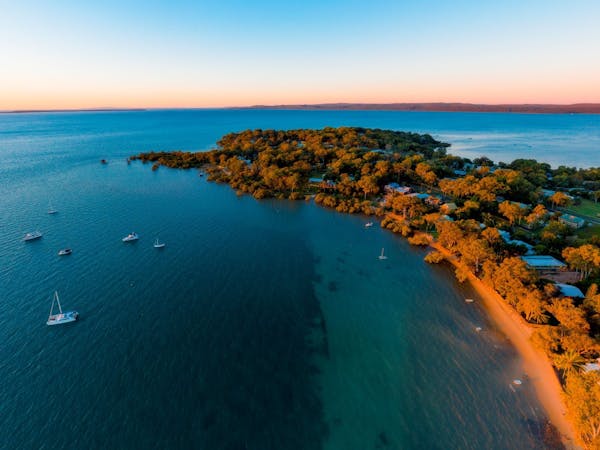
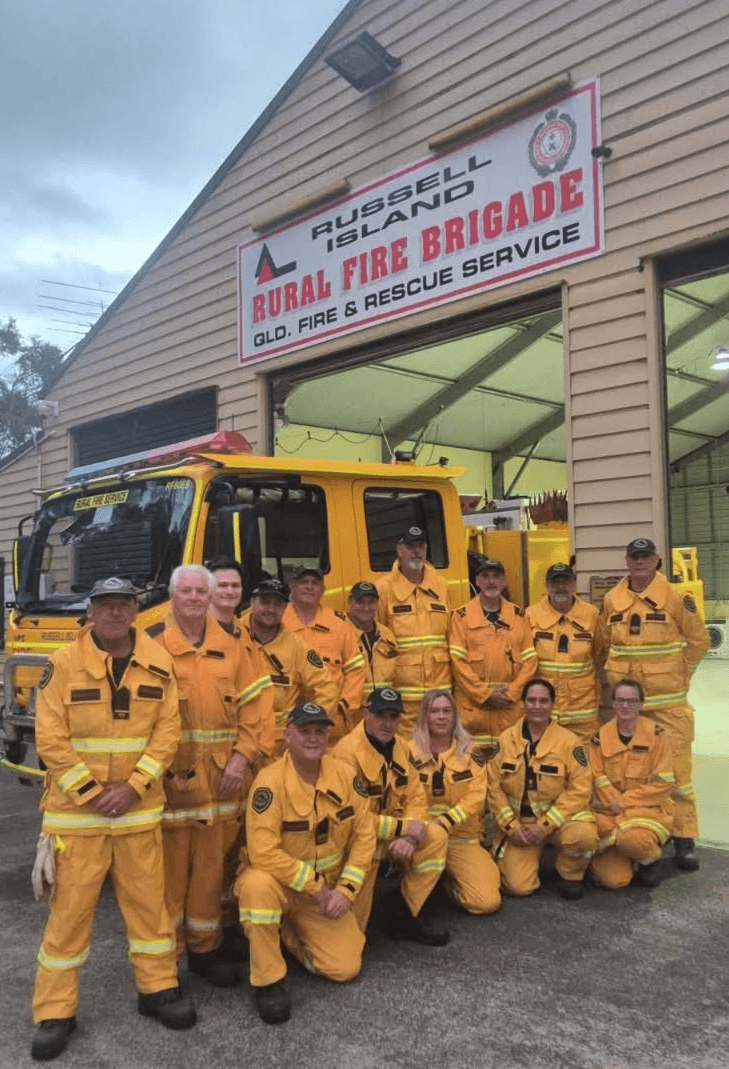
The first thing I noticed when I walked under Laurie’s house wasn’t the artwork. It was the smell of timber stain wafting through a workshop that has been lived in, worked in and loved.

Laurie Eastough was standing amongst the evidence. Paintings leaning against walls and windows, brushes scattered across benches, frames being stained and prepared and a giant artwork stretching across one wall. And, of course, a shark carved from a tree stump watching over it all.

But there was something else about Laurie that caught my attention. He claims he doesn’t know how old he is. I’m still not entirely convinced whether he genuinely doesn’t know, or whether he has simply decided that numbers are overrated and, like me, prefers the idea of being eternally thirty.

Laurie says he was born on a farm in Western Australia, delivered by a midwife who never got around to the paperwork. When he later needed a passport, his sister discovered there was no official record.

“My father reckons I was born in 1939,” he says with a casual shrug.

For Laurie, that was enough. Perhaps that attitude comes from growing up in a very different era. One where families were large, resources were limited and entertainment was something you created yourself.

Laurie was one of fifteen children; eight boys and seven girls; growing up on a wheat and sheep property near Geraldton. They didn’t have television, they had imagination. They told ghost stories at night, searched for birds’ nests, made up games and lay beneath wide open skies counting meteors; with a dozen shooting across the sky in a night considered nothing out of the ordinary.

Most of the children slept outside on the verandah because there simply wasn’t enough room inside. It was a different world. One where you caught ducks for dinner, trapped rabbits and learnt to shoot a rifle from a young age. One where you fixed things because replacing them wasn’t an option.

It is perhaps why Laurie still sees possibility where others see something discarded. A tree stump isn’t just a tree stump, it’s a shark or a female torso sculpture. Old timber isn’t rubbish, it’s waiting to become a frame. That way of thinking has followed Laurie throughout his life.

Laurie has always been a maker. Long before paintbrushes became his tool of choice, his hands were busy operating earthmoving machinery, steering fishing boats, racing motorbikes and building homes from the ground up. If something broke, he fixed it. If something didn’t exist, he built it. Art simply became another way of creating something with his hands.

When Laurie bought his block of land on Russell Island more than 30 years ago for $14,000, he wasn’t chasing luxury. He was chasing possibility. He built his own home for around $24,000, a figure that says as much about the era as it does about Laurie himself. It was a time when people didn’t wait for someone else to make things happen; they picked up the tools, worked it out and built what they needed.

That same philosophy followed him into art. He had always dabbled in painting, but after attending classes with his daughter-in-law, an art teacher told him he had talent. Fifty years later, he is still proving her right. Even arthritis, which has changed his hands and made painting more difficult, hasn’t managed to convince him to put the brushes away.

“I just keep going,” he says, as though there were never any other option.

His recent exhibition, Lajasper, named after the street he has called home for more than three decades, was more than a collection of paintings. Held at RicArts, it was a chance for the community to celebrate the imagination, humour and stories of a man who has quietly created his way through life. But the exhibition was about more than paintings, it was about community and friendship.

When I arrived at Laurie’s studio, Julie Menzies was there beside him, staining and painting the handmade frames that would showcase his artwork. It was such an ordinary moment, yet somehow it captured something extraordinary. Two people from different generations on two completely different life journeys, united by art.

Julie and Laurie found each other through RicArts, a place that has become a significant part of Laurie’s island life. For Laurie, the group represents connection. For Julie, it represents a friendship she never expected to find.

“He’s just a wonderful person, and he brings so much happiness to everyone around him,” Julie says.

And while Laurie has watched plenty of things change during his time on the island, some of his memories belong to a very different Russell Island. He remembers when there was a small convenience shop where Mitre 10 now stands. When the arrival of the IGA supermarket was a major milestone. When island life moved at a slower pace and people knew each other differently. The landscape and population has changed, but Laurie believes some things remain. People helping people.

Just when I thought I had seen the full extent of Laurie’s creativity, he introduced me to his water lift. I had never seen anything like it; a clever homemade contraption that uses water pressure to carry people and supplies to the top floor of his home without electricity. Laurie explained it with the excitement of someone unveiling a brand new invention, rather than something he has lived with for years.

Laurie wasn’t quite finished with the tour. He ushered me into the garage where a fluorescent green 1961 Wolseley sat basking in the afternoon light. It’s the sort of colour that would leave Kermit feeling understated and a car that seems to reflect its owner perfectly; impossible to overlook and entirely unconcerned by what anyone else thinks.

But perhaps what Laurie will be remembered for isn’t hanging on a wall, sitting beneath his house or tucked away in his garage. It’s the community around him. The friendships formed through RicArts, the people who have admired and bought his work, and the quiet way he has made this island a little more colourful simply by being part of it.

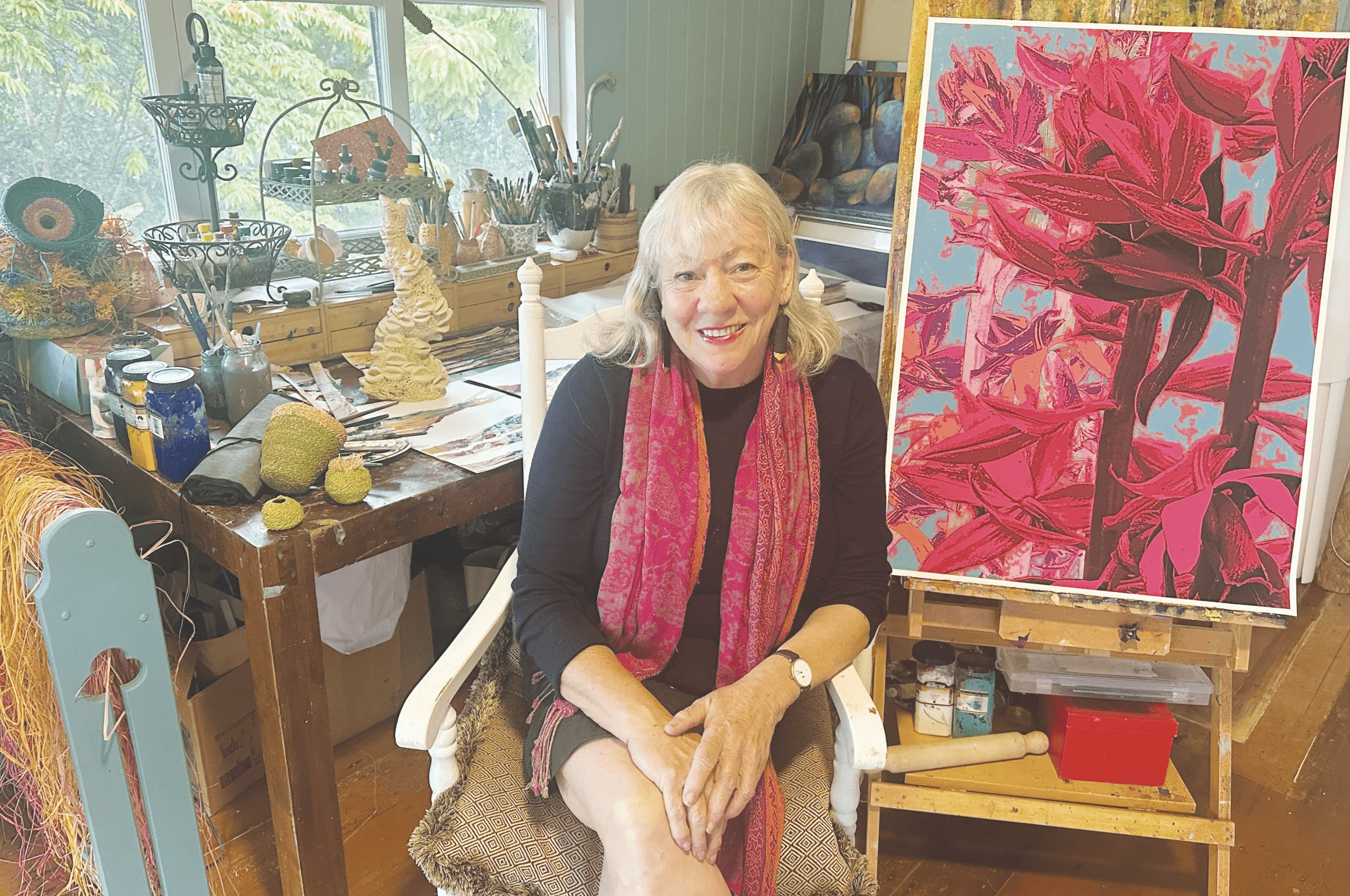
The first thing I noticed when I walked under Laurie’s house wasn’t the artwork. It was the smell of timber stain wafting through a workshop that has been lived in, worked in and loved.

Laurie Eastough was standing amongst the evidence. Paintings leaning against walls and windows, brushes scattered across benches, frames being stained and prepared and a giant artwork stretching across one wall. And, of course, a shark carved from a tree stump watching over it all.

But there was something else about Laurie that caught my attention. He claims he doesn’t know how old he is. I’m still not entirely convinced whether he genuinely doesn’t know, or whether he has simply decided that numbers are overrated and, like me, prefers the idea of being eternally thirty.

Laurie says he was born on a farm in Western Australia, delivered by a midwife who never got around to the paperwork. When he later needed a passport, his sister discovered there was no official record.

“My father reckons I was born in 1939,” he says with a casual shrug.

For Laurie, that was enough. Perhaps that attitude comes from growing up in a very different era. One where families were large, resources were limited and entertainment was something you created yourself.

Laurie was one of fifteen children; eight boys and seven girls; growing up on a wheat and sheep property near Geraldton. They didn’t have television, they had imagination. They told ghost stories at night, searched for birds’ nests, made up games and lay beneath wide open skies counting meteors; with a dozen shooting across the sky in a night considered nothing out of the ordinary.

Most of the children slept outside on the verandah because there simply wasn’t enough room inside. It was a different world. One where you caught ducks for dinner, trapped rabbits and learnt to shoot a rifle from a young age. One where you fixed things because replacing them wasn’t an option.

It is perhaps why Laurie still sees possibility where others see something discarded. A tree stump isn’t just a tree stump, it’s a shark or a female torso sculpture. Old timber isn’t rubbish, it’s waiting to become a frame. That way of thinking has followed Laurie throughout his life.

Laurie has always been a maker. Long before paintbrushes became his tool of choice, his hands were busy operating earthmoving machinery, steering fishing boats, racing motorbikes and building homes from the ground up. If something broke, he fixed it. If something didn’t exist, he built it. Art simply became another way of creating something with his hands.

When Laurie bought his block of land on Russell Island more than 30 years ago for $14,000, he wasn’t chasing luxury. He was chasing possibility. He built his own home for around $24,000, a figure that says as much about the era as it does about Laurie himself. It was a time when people didn’t wait for someone else to make things happen; they picked up the tools, worked it out and built what they needed.

That same philosophy followed him into art. He had always dabbled in painting, but after attending classes with his daughter-in-law, an art teacher told him he had talent. Fifty years later, he is still proving her right. Even arthritis, which has changed his hands and made painting more difficult, hasn’t managed to convince him to put the brushes away.

“I just keep going,” he says, as though there were never any other option.

His recent exhibition, Lajasper, named after the street he has called home for more than three decades, was more than a collection of paintings. Held at RicArts, it was a chance for the community to celebrate the imagination, humour and stories of a man who has quietly created his way through life. But the exhibition was about more than paintings, it was about community and friendship.

When I arrived at Laurie’s studio, Julie Menzies was there beside him, staining and painting the handmade frames that would showcase his artwork. It was such an ordinary moment, yet somehow it captured something extraordinary. Two people from different generations on two completely different life journeys, united by art.

Julie and Laurie found each other through RicArts, a place that has become a significant part of Laurie’s island life. For Laurie, the group represents connection. For Julie, it represents a friendship she never expected to find.

“He’s just a wonderful person, and he brings so much happiness to everyone around him,” Julie says.

And while Laurie has watched plenty of things change during his time on the island, some of his memories belong to a very different Russell Island. He remembers when there was a small convenience shop where Mitre 10 now stands. When the arrival of the IGA supermarket was a major milestone. When island life moved at a slower pace and people knew each other differently. The landscape and population has changed, but Laurie believes some things remain. People helping people.

Just when I thought I had seen the full extent of Laurie’s creativity, he introduced me to his water lift. I had never seen anything like it; a clever homemade contraption that uses water pressure to carry people and supplies to the top floor of his home without electricity. Laurie explained it with the excitement of someone unveiling a brand new invention, rather than something he has lived with for years.

Laurie wasn’t quite finished with the tour. He ushered me into the garage where a fluorescent green 1961 Wolseley sat basking in the afternoon light. It’s the sort of colour that would leave Kermit feeling understated and a car that seems to reflect its owner perfectly; impossible to overlook and entirely unconcerned by what anyone else thinks.

But perhaps what Laurie will be remembered for isn’t hanging on a wall, sitting beneath his house or tucked away in his garage. It’s the community around him. The friendships formed through RicArts, the people who have admired and bought his work, and the quiet way he has made this island a little more colourful simply by being part of it.
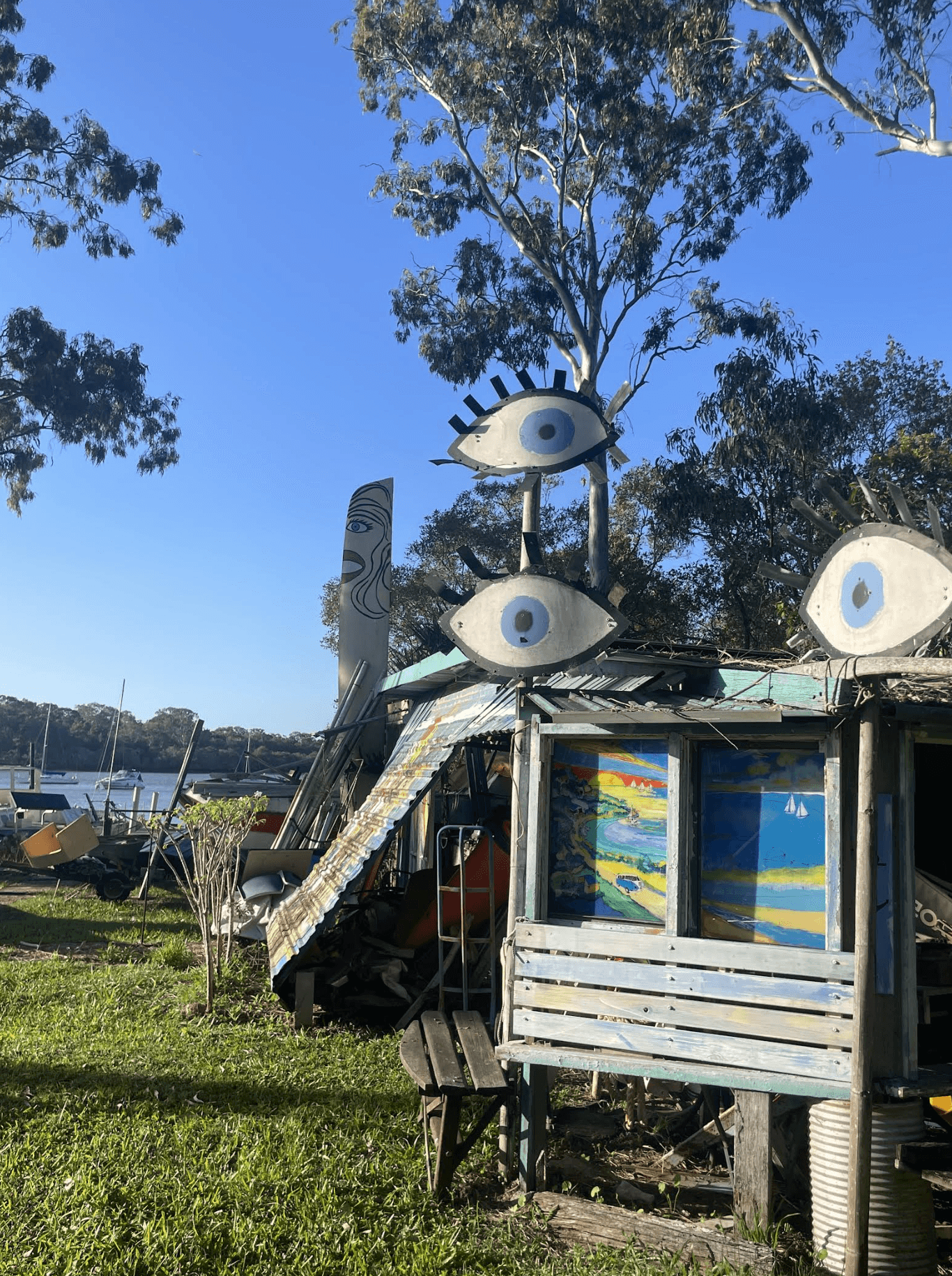
The first thing I noticed when I walked under Laurie’s house wasn’t the artwork. It was the smell of timber stain wafting through a workshop that has been lived in, worked in and loved.

Laurie Eastough was standing amongst the evidence. Paintings leaning against walls and windows, brushes scattered across benches, frames being stained and prepared and a giant artwork stretching across one wall. And, of course, a shark carved from a tree stump watching over it all.

But there was something else about Laurie that caught my attention. He claims he doesn’t know how old he is. I’m still not entirely convinced whether he genuinely doesn’t know, or whether he has simply decided that numbers are overrated and, like me, prefers the idea of being eternally thirty.

Laurie says he was born on a farm in Western Australia, delivered by a midwife who never got around to the paperwork. When he later needed a passport, his sister discovered there was no official record.

“My father reckons I was born in 1939,” he says with a casual shrug.

For Laurie, that was enough. Perhaps that attitude comes from growing up in a very different era. One where families were large, resources were limited and entertainment was something you created yourself.

Laurie was one of fifteen children; eight boys and seven girls; growing up on a wheat and sheep property near Geraldton. They didn’t have television, they had imagination. They told ghost stories at night, searched for birds’ nests, made up games and lay beneath wide open skies counting meteors; with a dozen shooting across the sky in a night considered nothing out of the ordinary.

Most of the children slept outside on the verandah because there simply wasn’t enough room inside. It was a different world. One where you caught ducks for dinner, trapped rabbits and learnt to shoot a rifle from a young age. One where you fixed things because replacing them wasn’t an option.

It is perhaps why Laurie still sees possibility where others see something discarded. A tree stump isn’t just a tree stump, it’s a shark or a female torso sculpture. Old timber isn’t rubbish, it’s waiting to become a frame. That way of thinking has followed Laurie throughout his life.

Laurie has always been a maker. Long before paintbrushes became his tool of choice, his hands were busy operating earthmoving machinery, steering fishing boats, racing motorbikes and building homes from the ground up. If something broke, he fixed it. If something didn’t exist, he built it. Art simply became another way of creating something with his hands.

When Laurie bought his block of land on Russell Island more than 30 years ago for $14,000, he wasn’t chasing luxury. He was chasing possibility. He built his own home for around $24,000, a figure that says as much about the era as it does about Laurie himself. It was a time when people didn’t wait for someone else to make things happen; they picked up the tools, worked it out and built what they needed.

That same philosophy followed him into art. He had always dabbled in painting, but after attending classes with his daughter-in-law, an art teacher told him he had talent. Fifty years later, he is still proving her right. Even arthritis, which has changed his hands and made painting more difficult, hasn’t managed to convince him to put the brushes away.

“I just keep going,” he says, as though there were never any other option.

His recent exhibition, Lajasper, named after the street he has called home for more than three decades, was more than a collection of paintings. Held at RicArts, it was a chance for the community to celebrate the imagination, humour and stories of a man who has quietly created his way through life. But the exhibition was about more than paintings, it was about community and friendship.

When I arrived at Laurie’s studio, Julie Menzies was there beside him, staining and painting the handmade frames that would showcase his artwork. It was such an ordinary moment, yet somehow it captured something extraordinary. Two people from different generations on two completely different life journeys, united by art.

Julie and Laurie found each other through RicArts, a place that has become a significant part of Laurie’s island life. For Laurie, the group represents connection. For Julie, it represents a friendship she never expected to find.

“He’s just a wonderful person, and he brings so much happiness to everyone around him,” Julie says.

And while Laurie has watched plenty of things change during his time on the island, some of his memories belong to a very different Russell Island. He remembers when there was a small convenience shop where Mitre 10 now stands. When the arrival of the IGA supermarket was a major milestone. When island life moved at a slower pace and people knew each other differently. The landscape and population has changed, but Laurie believes some things remain. People helping people.

Just when I thought I had seen the full extent of Laurie’s creativity, he introduced me to his water lift. I had never seen anything like it; a clever homemade contraption that uses water pressure to carry people and supplies to the top floor of his home without electricity. Laurie explained it with the excitement of someone unveiling a brand new invention, rather than something he has lived with for years.

Laurie wasn’t quite finished with the tour. He ushered me into the garage where a fluorescent green 1961 Wolseley sat basking in the afternoon light. It’s the sort of colour that would leave Kermit feeling understated and a car that seems to reflect its owner perfectly; impossible to overlook and entirely unconcerned by what anyone else thinks.

But perhaps what Laurie will be remembered for isn’t hanging on a wall, sitting beneath his house or tucked away in his garage. It’s the community around him. The friendships formed through RicArts, the people who have admired and bought his work, and the quiet way he has made this island a little more colourful simply by being part of it.